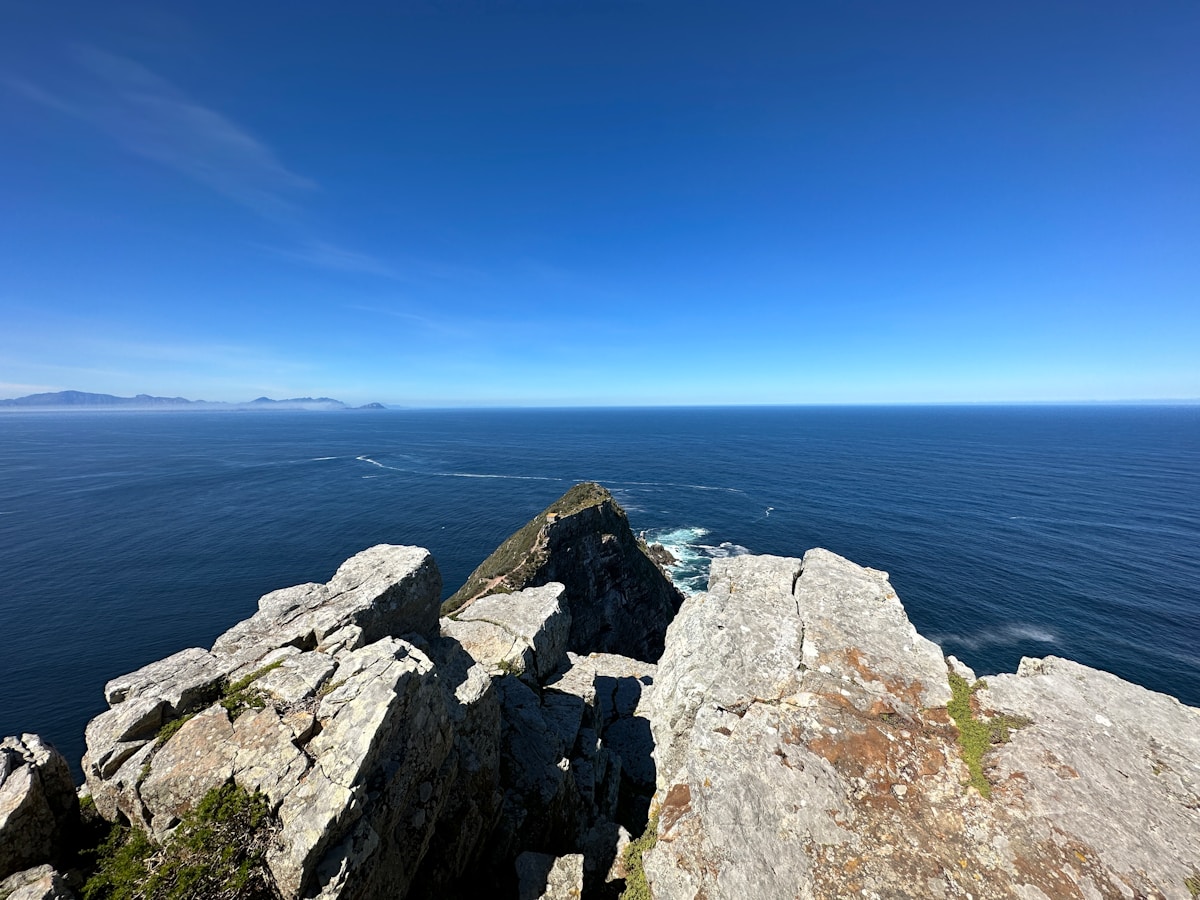
The Cape Peninsula drive is the most popular day trip from Cape Town, and it earns that status. The route south from the city takes in two oceans (the Atlantic on the west, False Bay on the east), the Cape of Good Hope nature reserve, the Cape Point lighthouse, a colony of African penguins, and the fishing villages of Hout Bay and Kalk Bay.
Allow a full day - 7–8 hours minimum if you’re covering the highlights properly.
Route Overview
Most visitors do the loop in one direction - down the Atlantic (west) side and back up the False Bay (east) side, or vice versa. The anticlockwise direction (down the Atlantic, up via Simon’s Town) is slightly more logical.
City Centre → Hout Bay (20–25 minutes) Drive south through Sea Point and Camps Bay, then over Suikerbossie Hill into Hout Bay. Stop for 20–30 minutes at Hout Bay harbour - fresh seafood, the boat trip to Duiker Island seal colony (R150, worth it), and a chaos of boats. The small harbour town is more lived-in than most Cape Town stops.
Hout Bay → Noordhoek → Kommetjie via Chapman’s Peak Drive (20 minutes) One of the most scenic drives in South Africa - a toll road (R45 per car) carved into the cliff face above the ocean. 9 km of hairpin bends with the Atlantic below. Stops at viewpoints are worth it, but don’t stop in the road itself. After Chapman’s Peak the road opens out through Noordhoek and Kommetjie, a quiet surfing village.
Kommetjie → Cape of Good Hope (30–40 minutes) The Cape Point section of Table Mountain National Park. Entry gates are at Scarborough. Cost: R353 per adult, R176 per child (2–11). Keep your receipt - it’s valid for the whole day and lets you re-enter.
The park road winds through fynbos heath for about 10 km to the Cape Point parking area. The landscape is open, windswept, and dramatically beautiful.
At Cape Point
From the main car park, two paths lead up to the old lighthouse at the top:
Flying Dutchman funicular - R70 one way, R105 return. Takes 5 minutes. Opens at 09:00.
Foot path - 20–25 minutes steep but manageable walk. Most people walk up and take the funicular down, or walk both.
The lighthouse itself is now decommissioned - the working light is on a lower point (which isn’t usually visited). The views from the top are exceptional when clear - the cliff drops 250 m straight into the sea.
Allow 1.5–2 hours at Cape Point.
Tip on baboons: Chacma baboons live in the park and are habituated to tourists. Don’t feed them, don’t get between a mother and infant, lock your car, and don’t leave food visible. They are strong and aggressive and will reach into open windows for food.
Cape of Good Hope
The actual Cape of Good Hope - the most southwesterly point of Africa - is a 2 km (one-way) walk south from the Cape Point car park along a good gravel path through fynbos. It’s less dramatic visually than Cape Point but historically significant. The famous sign (“Cape of Good Hope”) makes for the obligatory photo.
Return via False Bay - Simon’s Town and Boulders Beach
The return route up the east side of the peninsula is less dramatic than Chapman’s Peak but essential if you want to see the penguins.
Simon’s Town is a naval base town with Victorian architecture, a pleasant main street, and good fish restaurants. Worth a 30-minute stop.
Boulders Beach (R220 per adult) is 2 km south of Simon’s Town. The colony of around 2,000 African penguins has been here since 1982 and has grown steadily. Entry through the SANParks boardwalk brings you to the beach where penguins nest, moult, and waddle around at close range. You can share the beach with them. Go early (before 09:00) or after 16:00 to avoid the heaviest crowds.
Kalk Bay on the way back is worth a stop - a bohemian fishing village with antique shops, the Brass Bell pub right on the water, and an active fishing harbour with seals.
Tour vs Self-Drive
Self-drive is the most flexible option. You set the pace, can linger longer at Boulders, and spend time at Chapman’s Peak. Car hire from Cape Town costs R400–700 per day through major agencies. You’ll need fuel - allow R200–300 for a full loop.
Organised tours (R700–1,400 per person) typically cover the same route with a guide and include entry fees. They’re efficient but you’re on someone else’s schedule. GYG has multiple options - most pick up at the V&A Waterfront and last 7–9 hours.
Practical Notes
- Start before 09:00 to beat the crowds at Boulders and have time at Cape Point before the wind picks up.
- Fill up with fuel before leaving - there are no petrol stations inside the national park.
- Bring layers - Cape Point is exposed and can be very cold and windy even on warm days.
- The park closes at 18:00.
- Mobile signal is patchy inside the park but present at Cape Point and Boulders Beach.
Ready to plan your trip? Tours & Activities in Cape Town, or Car Hire in Cape Town.
Continue Exploring Cape Town
- Cape Town city guide - full overview of things to do and where to stay
- Boulders Beach penguins - detailed guide to the penguin colony, including best times to arrive
- Cape Town Winelands day trip - the other great Cape Town day out
- Day trips from Cape Town - full overview of all excursions from the city
- 3 days in Cape Town - how to fit the peninsula into a short trip
- Table Mountain guide - the natural partner to a Cape Peninsula day
- Western Cape region guide - where the peninsula fits in the broader province Search hotels in Cape Town on Booking.com