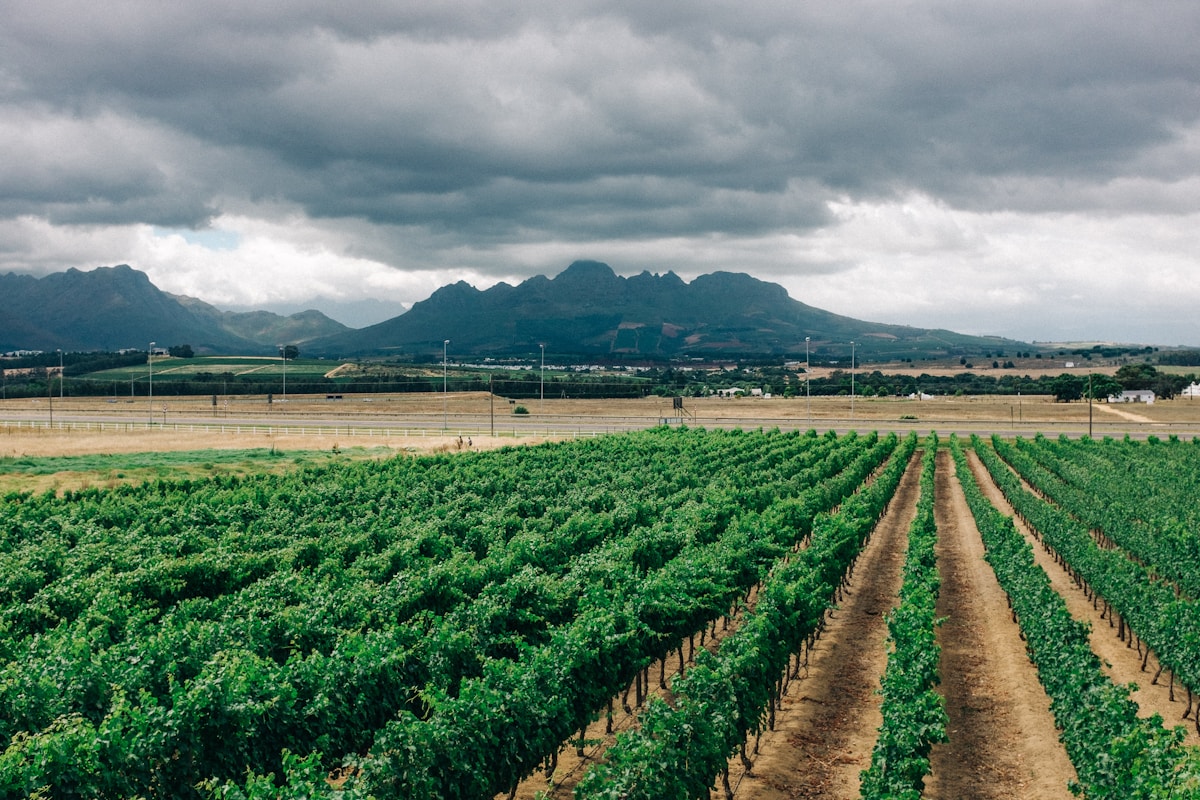
The Cape Winelands produce some of the world’s finest wine. The combination of Mediterranean climate (hot, dry summers; cool, wet winters), diverse soils - decomposed granite in Stellenbosch, clay in Franschhoek, sandstone on the Swartland plains - and 350 years of winemaking tradition has produced a wine culture that stands comparison with Burgundy, Napa, or the Barossa.
The price point is the other advantage: a bottle that would cost €50 in a Burgundy cellar costs R300–500 in Stellenbosch. A tasting of 6 premium wines costs what a single glass would in comparable European regions.
What the Cape Grows
Chenin Blanc is the most widely planted variety in the Cape and arguably its greatest strength. Old vine Chenin from the Swartland and Stellenbosch can be extraordinary - complex, long-lived, from bone-dry to off-dry styles.
Pinotage is South Africa’s own crossing (Pinot Noir × Cinsault, created in 1925). At its worst it’s jammy and acetone-heavy; at its best (Kanonkop, L’Avenir) it’s deeply savoury, dark-fruited, and uniquely South African.
Cabernet Sauvignon - Stellenbosch produces serious, age-worthy Cab from its granite soils. Rust en Vrede, Tokara, and Vergelegen are consistently at the top.
Syrah/Shiraz - both the cool-climate, peppery Syrah style (Eben Sadie, Boekenhoutskloof) and the riper Stellenbosch Shiraz style.
Cap Classique - South Africa’s traditional-method sparkling wine. Franschhoek leads, especially Haute Cabrière’s Pierre Jourdan range and Graham Beck (whose Brut was served at Barack Obama’s inauguration). From R150 per bottle.
Grenache and Rhône blends - increasingly important, especially from the Swartland.
Stellenbosch
Stellenbosch is the academic centre of the Cape wine industry (Stellenbosch University’s viticulture and oenology faculty is here). The town centre has a well-preserved Cape Dutch streetscape and a dense concentration of estates in the surrounding valleys.
Selected estates:
- Kanonkop - benchmark Pinotage. Serious, unstuffy. Tasting by appointment R200.
- Rust en Vrede - focused, single-site Cab and Syrah. Restaurant on site.
- Tokara - excellent across the range, olive oil and wines. Tasting R200, waived on purchase.
- Delaire Graff - luxurious estate, art collection, outstanding lodge and restaurant. Tasting R350.
- Jordan - consistent quality across whites and reds, popular restaurant. Tasting R200.
- Spier - large, accessible, family-friendly, Eagles Encounters falconry show. Entry-level but well-made. Tasting R150.
- Simonsig - the founders of Cap Classique in South Africa. Knowledgeable staff, good cellar door. R165 for a 5-wine tasting.
Search hotels in Stellenbosch on Booking.com
Franschhoek
The valley has the best restaurant scene in South Africa, and several estates worth serious attention.
- Haute Cabrière - Pierre Jourdan Cap Classique range, underground cellar. R225 for a Pinot Noir and Cap Classique tasting.
- La Motte - established estate, good Shiraz, art collection, Pierneef Restaurant. R250.
- Boekenhoutskloof - the “Chocolate Block” blend and the flagship Syrah are among the Cape’s best. Limited visits - book well ahead.
- Babylonstoren - 300-year-old farm, extraordinary garden, acclaimed restaurant (book months ahead). Farm shop, herb garden. R200 for wine tasting.
- Mont Rochelle - Richard Branson’s estate (now sold on), views over the valley. R230.
The Franschhoek Wine Tram is a hop-on hop-off service connecting about 20 estates in the valley - worth it for groups or anyone who doesn’t want to drive. Tickets R190–270. Runs from 09:30.
Paarl
Often overlooked, Paarl has some significant estates.
- Fairview - goats on a tower, a broad range of cheese and wine. Accessible, fun, good-value. Tasting R150.
- Glen Carlou - excellent Chardonnay and Bordeaux blends. R200 for 5 wines.
- Perdeberg - specialist Chenin Blanc estate. R180.
Swartland (worth the detour)
An hour north of Cape Town on the R46, the Swartland is where South Africa’s wine revolution is happening. Rocky, granite-rich soils, dry-farmed old vines, natural wine approach. Eben Sadie and AA Badenhorst are the headline names. Tastings available at their cellars in season - call ahead.
Logistics
Don’t drink and drive. This is both illegal (blood alcohol limit 0.05 g/100ml) and genuinely dangerous on the winding mountain passes. Options:
- Hire a driver for the day: R800–1,500 for a private driver based in Stellenbosch
- Uber works between Stellenbosch town and many estate entrances (not all)
- Organised wine tours from Cape Town - typically R600–900 per person, usually visiting 2–3 estates
- The Franschhoek Wine Tram - no driving needed in the Franschhoek valley
- Stay overnight in Stellenbosch or Franschhoek - the obvious solution for serious tasters
Top Cape Winelands Tours & Prices
Options range from the independent Wine Tram to full guided days from Cape Town:
| Tour | Duration | Price from | What’s Included |
|---|---|---|---|
| Franschhoek Wine Tram Day Pass | 5–6 hrs | from R380 per person | Hop-on hop-off tram all day, access to 16 estates (tastings extra, typically R100–200 per estate) |
| Cape Town: Stellenbosch & Franschhoek Wine Tour | 8 hrs | from R2,000 per person | 3 estate tastings, 15 wines including pairing, guided Stellenbosch walk, hotel pickup |
| Cape Town: Full Day Cape Winelands Tour (4 Estates) | 8 hrs | from R2,250 per person | 4 award-winning estates, included tastings, 2-course lunch, hotel pickup and drop-off |
| Cape Town: 3 Wine Regions in 1 Day (Paarl, Stellenbosch, Franschhoek) | 8 hrs | from R2,300 per person | 3 estates, 15 wines, cheese pairing, scenic Franschhoek Pass drive |
Self-drive note: If hiring a car, designate a non-drinking driver — blood alcohol limit is 0.05 g/100ml and checkpoint policing on the R44 and R310 is active. Guided tours handle this for you.
Browse Cape Winelands guided tours on GetYourGuide
Ready to plan your trip? Cape Winelands Tours, Car Hire in Cape Town, or Tours & Activities in Cape Town.
See Also
- Stellenbosch destination guide - complete guide to South Africa’s wine capital
- Franschhoek Wine Tram guide - hop-on hop-off wine tour through the Franschhoek valley
- Cape Winelands day trip from Cape Town - Stellenbosch, Franschhoek, and Paarl in one day
- Western Cape region guide - where the Winelands fit in the province
- Cape Town food guide - wine pairs well with the Cape Town restaurant scene
- Cape Winelands vs Stellenbosch comparison - choosing between the wine area and the town
- Stellenbosch vs Franschhoek comparison - the two main valley towns compared
- 3-day Cape Town itinerary - Day 3 is the Winelands day
- Last-minute tours - same-day Winelands and Cape Town tour availability for last-minute bookings