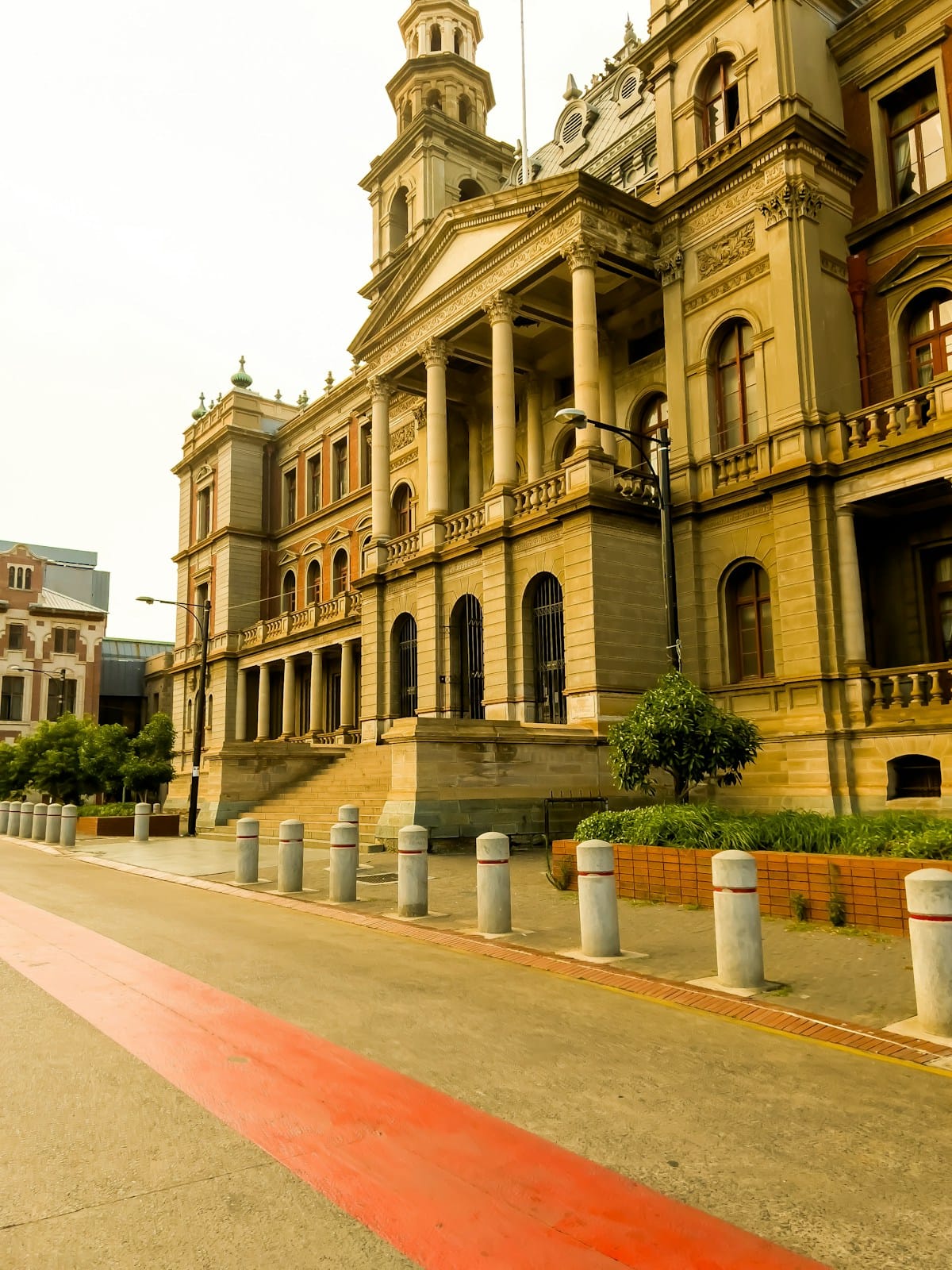
Pretoria — the administrative capital of South Africa and part of the City of Tshwane Metropolitan Municipality — rewards visitors who take time to look past its government-town reputation. The Union Buildings, Freedom Park, Voortrekker Monument, and Kruger House all sit within easy reach of each other. In October and November, some 70,000 jacaranda trees turn the city’s streets and parks a deep lilac-purple that you will not find anywhere else in southern Africa.
Most visitors come from Johannesburg (40 km south) on a day trip. That is enough time for the main sights. Two days gives you room for Rietvlei Nature Reserve, the Cullinan Diamond Mine, and a proper explore of Hatfield’s food scene.
Union Buildings
The Union Buildings are the seat of South Africa’s executive government and the most architecturally significant building in the capital. Herbert Baker designed them in 1910 in a hybrid neo-Renaissance and Cape Dutch style — two wings positioned on a hillside so they face a shared amphitheatre, a deliberate symbol of equal standing between English and Afrikaans speakers in the new Union.
The grounds are open to the public daily. A 9-metre bronze statue of Nelson Mandela stands in the formal gardens — arms outstretched, facing the amphitheatre where he was inaugurated on 10 May 1994 as South Africa’s first democratically elected president. The view from the terrace across Pretoria’s rooftops and the Magaliesberg hills to the north is one of the better panoramas in the country.
The building interior is not publicly accessible. Plan 45–60 minutes for the gardens and the view.
- Entry: Free
- Hours: Daily, sunrise to sunset
- Getting there: Uber from Hatfield approximately R40; from CBD approximately R60
Voortrekker Monument
Ten kilometres south of the city centre on a prominent koppie, the Voortrekker Monument is one of the most politically charged structures in South Africa. Built in 1938 and completed in 1949 during the early apartheid era, it commemorates the Afrikaner Voortrekkers who left the Cape Colony in the Great Trek of the 1830s–1840s.
The Hall of Heroes inside contains a 27-panel marble frieze — the longest of its kind in the world — depicting Voortrekker history from 1835 to 1852. The engineering marvel is the cenotaph at the building’s centre: once a year, on 16 December (the Day of the Covenant) at exactly noon, a shaft of sunlight passes through an oculus in the dome and illuminates the words “Ons vir jou, Suid-Afrika” (We for you, South Africa). This is not coincidence. It was deliberately calculated by the architects.
The adjacent Heritage Site adds historical context through exhibits covering the Trek, its causes, and its consequences. Visiting both takes 90 minutes to two hours and is worth doing properly.
- Entry: Approximately R130 adults, R65 children (as of 2026)
- Hours: Daily 8am–5pm
- Getting there: 10 km south of CBD; best reached by car, Uber, or as part of a guided city tour
Freedom Park
Freedom Park sits on the koppie immediately adjacent to the Voortrekker Monument, and the proximity is deliberate. Opened in 2004, it is a memorial to all those who died in conflicts on South African soil — from pre-colonial wars through colonial conquest, the Anglo-Boer Wars, and the liberation struggle.
The Wall of Names lists more than 75,000 individuals. The architectural language — open, landscape-integrated, designed by Mashabane Rose Architects — is the opposite of the Voortrekker Monument’s authoritarian granite enclosure. The two memorials are connected by a “thread of reconciliation” path; walking between them is one of the more thought-provoking experiences available in South Africa.
A guided tour (included in the entry fee) explains the seven thematic gardens and their connections to South African history. The isivivane (a cairn of stones from each of South Africa’s nine provinces) is a particularly moving element.
- Entry: Approximately R100 adults (as of 2026)
- Hours: Tuesday to Sunday, 8am–4:30pm (closed Mondays)
- Getting there: Adjacent to Voortrekker Monument; combine both in a half-day
Kruger House Museum
Paul Kruger’s Pretoria residence is one of the best-preserved examples of Victorian-era domestic architecture in South Africa. Kruger — known as Oom Paul — was President of the South African Republic (ZAR) from 1883 to 1900 and the dominant political figure of the Boer cause during the Anglo-Boer War. He lived here until the war forced him into exile in 1900, where he died in Switzerland in 1904.
The museum houses original furniture, personal items, Kruger’s state carriage, and two stone lions at the entrance that became symbols of the Republic. The house gives a vivid sense of the domestic life of the man who resisted British imperial expansion until the very end.
- Entry: Approximately R50 adults (as of 2026)
- Hours: Monday to Friday 8am–4pm, Saturday 8am–1pm
- Location: Church Street, Pretoria CBD — a short walk from Church Square
Church Square
Church Square is the historic heart of the Pretoria CBD. The pedestrianised plaza is surrounded by neo-classical buildings including the old Raadsaal (Parliament of the South African Republic), the Palace of Justice (where the Rivonia Trial that sentenced Nelson Mandela took place in 1963–64), and the Transvaal Provincial Administration building.
A large bronze statue of Paul Kruger stands at the centre. The square is best visited as part of a short CBD walk taking in the surrounding façades; the immediate surrounding streets have rough edges, so keep to the open plaza.
- Entry: Free, open 24 hours
- Location: CBD, between Paul Kruger Street and Church Street
National Botanical Garden (Brummeria)
Run by the South African National Biodiversity Institute (SANBI), the National Botanical Garden in Brummeria covers 76 hectares and is the country’s premier showcase for indigenous South African flora. The collection is particularly strong on aloes, succulents, and highveld vegetation types. Hiking trails wind through both formally planted sections and more natural bushveld scrub.
The garden is calm and uncrowded on weekday mornings. Worth combining with the adjacent Rietvlei Nature Reserve for a full nature morning.
- Entry: Approximately R180 adults (as of 2026)
- Hours: Monday to Friday 7am–6pm; weekends 7am–6pm
Rietvlei Nature Reserve
Twenty kilometres south of the city, Rietvlei is Gauteng’s best accessible day reserve. At 3,800 hectares, it supports white rhino, lion, cheetah, buffalo, sable antelope, eland, and more than 270 recorded bird species. Self-drive game viewing is the primary activity; a small camp with chalets is available for overnight stays.
Search hotels in Pretoria on Booking.com
The reserve is uncrowded compared to Pilanesberg or Kruger and is genuinely well-stocked with wildlife. Early morning (gates open at 6am) gives the best sightings. Bird hides near the dam are productive year-round.
- Entry: Approximately R200 adults, R95 children (as of 2026)
- Hours: Daily 6am–6pm
- Getting there: 20 km south of Pretoria CBD; car essential
Pretoria Zoo (National Zoological Gardens)
The National Zoo occupies 85 hectares in the Pretoria CBD and is one of the largest zoos in Africa. It houses over 700 species. The aerial cable car across the zoo provides views over the collection and the surrounding city.
Best for families and younger visitors. The African Plains exhibit and nocturnal animal house are the strongest sections.
- Entry: Approximately R195 adults, R105 children as of 2026
- Hours: Daily 8am–5pm
- Location: Paul Kruger Street, CBD
Jacaranda Season
Pretoria has approximately 70,000 jacaranda trees (Jacaranda mimosifolia) — more than any other city in the world outside of Johannesburg and Pretoria themselves. Jacaranda season runs from mid-October to mid-November, peaking in late October.
The effect is genuinely dramatic. Streets in Arcadia, Sunnyside, Hatfield, and around the University of Pretoria turn a deep lilac-purple. Brooklyn and New Muckleneuk residential streets have dense canopy coverage. The University of Pretoria grounds during peak bloom are particularly striking.
University Avenue (between Hatfield and the campus) and Church Street through Arcadia are the best single drives. The walking path from Union Buildings down towards Arcadia gives elevated views over the purple canopy below.
Accommodation books up earlier than usual in late October — reserve at least four to six weeks ahead if visiting during peak jacaranda season.
Practical Information
Getting around: Uber and Bolt work well across the city. A car is useful for Rietvlei, Voortrekker Monument, and Freedom Park, which are spread away from the centre. The Gautrain from Johannesburg (Sandton or Rosebank) reaches Hatfield in 35–40 minutes at approximately R95–R100 as of 2026.
Best time to visit: May to August for dry, sunny weather. October to November for jacaranda season. Avoid the December–January peak summer if you dislike afternoon thunderstorms.
Safety: Stick to known tourist areas. Church Square and the immediate CBD have some rough patches — use Uber rather than walking between sites. Hatfield, Arcadia, and Brooklyn are comfortable on foot during the day.
For the broader Gauteng region context see the Gauteng travel guide. Combining Pretoria with Johannesburg makes for a strong two-to-three day Gauteng itinerary.