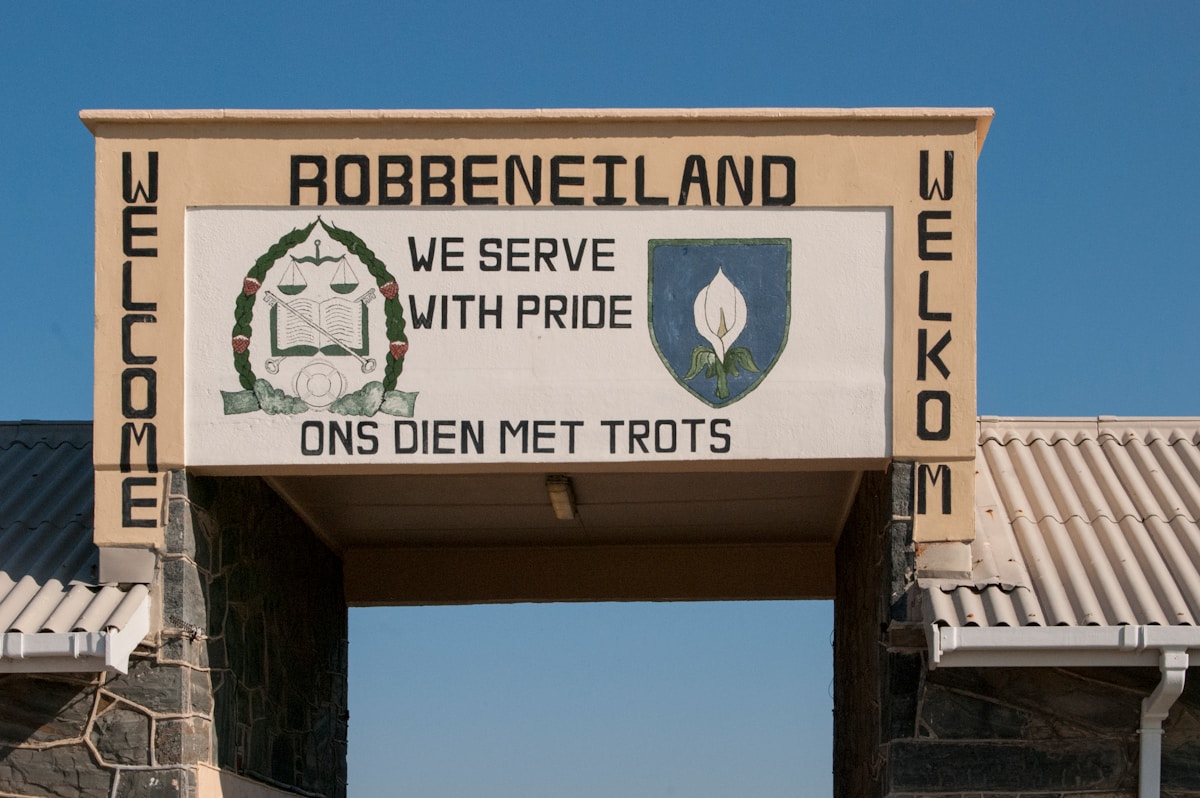
Robben Island sits 11 km off the Cape Town shore in Table Bay - a 40-minute ferry ride from the V&A Waterfront. For 400 years it served as a place of exile and imprisonment: Dutch colonial authorities used it for lepers and political prisoners from the 17th century onwards; under apartheid it became the maximum security prison where Nelson Mandela, Walter Sisulu, Ahmed Kathrada, and hundreds of other political prisoners were held.
Since 1999 it has been a UNESCO World Heritage Site. More than 1.5 million people visit each year. The most distinctive part of the tour is that former political prisoners serve as guides - people who were incarcerated here, who walk you through the sections where they were held, and who speak from direct experience.
Book accommodation in Cape Town’s V&A Waterfront or City Bowl for the closest overnight base. Ferries depart from the Robben Island jetty next to the Clock Tower at the V&A Waterfront.
Booking
Book online at robben-island.com - not at the gate. The tours sell out, particularly in peak summer season (November–February), school holidays, and long weekends. Book 1–2 weeks ahead as a minimum; 3–4 weeks for December–January travel.
Ticket price (as of 2026): approximately ZAR 700 per adult for the return ferry plus the island tour. Reduced rates for children (under 18) and South African residents. Confirm current prices when booking.
What the ticket includes: Return ferry from the Nelson Mandela Gateway at the V&A Waterfront, a guided bus tour of the island covering key sites including the limestone quarry, Mandela’s garden, and the Blue Slate Quarry, and a guided walk through the Maximum Security Prison.
Cancellation policy: Ferries are weather-dependent. In rough sea conditions (Table Bay can be very choppy, particularly June–August), departures may be cancelled and rescheduled. If your ferry is cancelled, you’ll be given a new departure time - usually the next available slot. Plan your day with flexibility.
Getting to the Ferry
The Robben Island ferry departs from the Nelson Mandela Gateway at the V&A Waterfront, Clock Tower area. Allow 20 minutes from the city centre by Uber. The Gateway building has ticket collection points - collect your tickets at least 30 minutes before departure.
Departure times (as of 2026): typically 09:00, 11:00, and 13:00, with return ferries approximately 2.5–3 hours after each departure. Check exact times when booking - schedules change seasonally.
Travel sickness: The channel crossing can be rough, especially in winter (June–August). If you’re prone to seasickness, take medication before boarding. The crossing on a calm day is pleasant; on a rough day it is unpleasant but short.
The Tour
Island Bus Tour (1 hour)
On arrival, groups board open-sided buses driven by island residents and guided by a commentator. The bus tour covers:
Lime Quarry - where political prisoners, including Mandela, were forced to work breaking limestone for years. The reflected glare from the white rock permanently damaged Mandela’s eyes - he required surgery later in life. The quarry is preserved as it was; you stand at the edge where prisoners chipped stone.
Mandela’s Garden - a small garden that Mandela cultivated in an area between the prison sections. It represented one of the few small acts of agency available to prisoners. Former prisoners still tend it.
Blue Slate Quarry - where prisoners were assigned to work after the lime quarry. Heavier work, less damaging to eyesight.
Pan-African monuments - various memorials to political prisoners from across Africa who were held here, including leaders of the Zimbabwe African National Union (ZANU) and others.
Maximum Security Prison Walk (1 hour)
The second part of the tour is a guided walk through the Maximum Security Prison, led by a former political prisoner. This is the most powerful part of the visit.
Your guide walks you through the cell blocks, communal cells, isolation cells, and the kitchen. They describe the daily routine, the forms of punishment, the hierarchy among prisoners and guards, and the remarkable story of how political education continued clandestinely behind bars - prisoners secretly teaching each other, organizing study groups, conducting what they called “Robben Island University.”
Nelson Mandela’s cell (Section B, Cell 5) - the single cell where Mandela spent 18 of his 27 years. It is small - approximately 2.5 m × 2.5 m - with a thin sleeping mat, a single bucket, and a small window. You view it through the open door; you do not enter. The guide stands outside and speaks from memory about what it was like to be imprisoned here.
The guards’ perspective is also addressed - some guards were harsh, some developed unexpected relationships with prisoners, and the complexity of that period is not reduced to a simple narrative.
Practical Notes
| Best time to visit | Summer (November–March) for calmer seas; winter for fewer crowds |
| Worst weather for crossing | June–August: Table Bay can be rough |
| Dress | Wind and exposed on the island - bring a layer even in summer |
| Photography | Permitted throughout, including in the cell blocks |
| Food | Bring snacks and water; the island has a basic café but selection is limited |
| Duration | Allow 4 hours door-to-door from V&A Waterfront |
Context: The History
Robben Island’s use as a prison spans four centuries. Under VOC rule, the Dutch East India Company banished political opponents and enslaved people here from the 1650s. Krotoa (Eva), the Khoi woman who served as an interpreter between the Dutch and the Khoi, died here in 1674 after being exiled to the island. Islamic leaders and Malay political prisoners were sent here from the 17th century onwards - the island has two mosques, and the Cape Malay community’s roots include families whose ancestors were imprisoned here.
Under apartheid, the island became the destination for leaders of the ANC, PAC, and other liberation movements sentenced under the Suppression of Communism Act and other apartheid-era laws. Mandela arrived in 1964 following the Rivonia Trial. The last political prisoners left in 1991. Prison staff stayed until 1996.
Today the island still has approximately 200 permanent residents - former staff and their descendants - whose children are schooled on the mainland.
Top Robben Island Tours & Prices
Three tiers available on GetYourGuide, all with free cancellation up to 24 hours before departure:
| Tour | Duration | Price from | What’s Included |
|---|---|---|---|
| Robben Island Ferry & Museum Tour | 3.5 hrs | from R825 per person | Return ferry from V&A Waterfront, island bus tour, prison guided walk with a former political prisoner |
| Robben Island + Cape Town City Highlights | 6 hrs | from R1,400 per person | Above + Bo-Kaap walking tour, V&A Waterfront, minibus with guide |
| Robben Island + Table Mountain Full Day | 8–9 hrs | from R2,500 per person | Robben Island, Table Mountain cableway ticket, Cape Town city sights, private vehicle |
Booking note: Robben Island tickets sell out well in advance in December–January and around South African school holidays. Book at least 5–7 days ahead in peak season; same-day availability is rare. All prices quoted are for international visitors — South African ID holders pay a reduced rate at the museum counter.
Browse Robben Island tours & ferry tickets on GetYourGuide
Ready to plan your trip? Attraction Tickets in South Africa, Tours & Activities in Cape Town, or Car Hire in Cape Town.
Next
- Cape Town city guide - city overview and orientation, including the V&A Waterfront area
- Cape Town where to stay - hotels by neighbourhood, closest to the Waterfront ferry
- Cape Town day trips overview - comparing Robben Island with the peninsula, Winelands, and Hermanus
- Cape Peninsula day trip guide - combine with Table Mountain, Cape Point, and Boulders Beach
- 7-day Cape Town itinerary - how Robben Island fits into a full week in Cape Town
- Soweto destination guide - another essential apartheid-era site, in Johannesburg