Search hotels in Drakensberg on Booking.com | Browse Drakensberg hiking tours
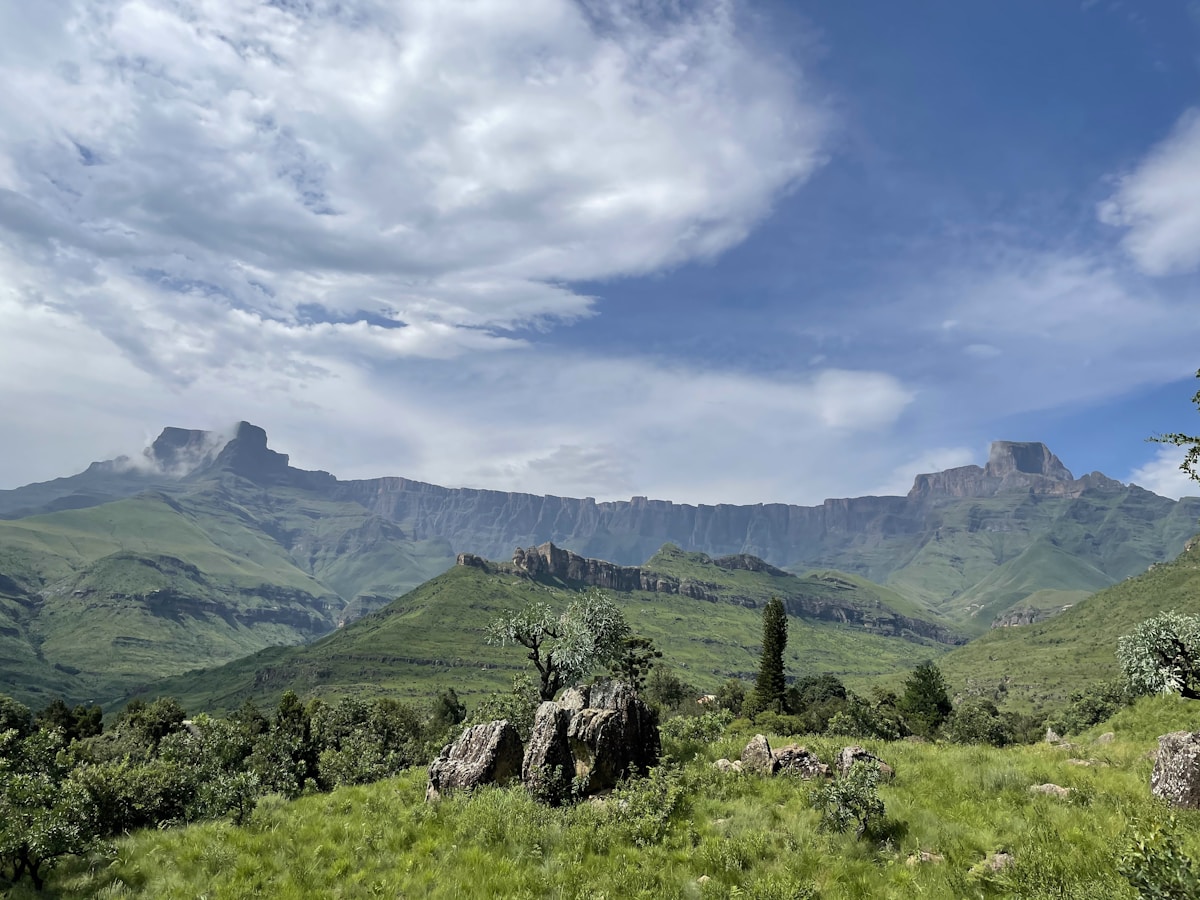
The Drakensberg - uKhahlamba in isiZulu, meaning “barrier of spears” - forms the spine of KwaZulu-Natal’s interior, a 200-kilometre basalt escarpment rising to 3,482 metres at Thabana Ntlenyana on the Lesotho border. For hikers, it is one of the finest mountain environments in Africa: high-altitude plateaus, 1,000-metre cliff faces, ancient San rock art, and an extraordinary density of trails from gentle valley walks to demanding multi-day routes.
The range divides broadly into Northern Berg (Royal Natal National Park - Amphitheatre, Tugela Falls), Central Berg (Cathedral Peak, Giants Castle), and Southern Berg (Sani Pass area, Giant’s Cup Trail). Each section has its own character. This guide covers the four most-hiked routes and everything you need to plan the trip from Johannesburg or Durban.
Drakensberg at a Glance
| Province | KwaZulu-Natal |
| Highest peak | Injasuti (3,459m, SA side) |
| UNESCO status | uKhahlamba-Drakensberg Park (World Heritage Site, 2000) |
| Best season | April–September (dry; clear skies) |
| Malaria risk | None - the Berg is malaria-free |
| Drive from Johannesburg | 4–5 hours (Northern Berg via N3) |
| Drive from Durban | 2–3 hours (Northern Berg via N3) |
| Permit required? | Yes - conservation fees at all SANParks/ezemvelo entry points |
Best Time to Visit
April to September is the Drakensberg hiking season. Winter days are cool and clear, afternoon thunderstorms (the Berg’s primary summer hazard) are largely absent, and the plateau views from escarpment-level trails are at their best. Snow is possible on the high escarpment June–August - bring layers even for day hikes.
October to March brings heavy afternoon rain and frequent lightning above 2,500 metres. Summer is more lush and waterfalls run at full volume, but lightning on the open escarpment is a genuine danger - you should be below the rim by 13:00 at the latest. Flash flooding in the gorges (including Tugela Gorge) can make trails impassable with little warning.
Peak school holiday periods (June/July and December/January) are busy - book accommodation 2–3 months ahead.
The Hikes
1. Tugela Gorge Trail - Easy
Distance: 14km return (7km each way)
Duration: 5–6 hours return
Elevation gain: Approximately 350m
Start: Mahai Campsite, Royal Natal National Park
Difficulty: Easy to moderate - suitable for fit walkers; some scrambling in the gorge
The Tugela Gorge trail is the most accessible introduction to Royal Natal. It follows the Tugela River upstream through increasingly dramatic cliff scenery to the base of Tugela Falls - at approximately 948 metres, the world’s second-tallest waterfall, dropping in five successive leaps from the Amphitheatre rim.
The trail begins flat through open grassland before narrowing into the gorge. The final section passes through two short rock tunnels - low enough to require crouching - cut through buttresses in the cliff. The payoff is a view straight up the Amphitheatre wall to the Tugela spilling over the rim 600 metres above.
Permits: Conservation fee approximately R220 per adult per day (international visitors) as of 2026, paid at the Royal Natal Park office at Mahai Campsite. Open daily 08:00–16:30 (gates close at 18:00).
What to bring: Water (2 litres minimum), snacks, sunscreen, hiking shoes with grip. The gorge is shaded but the grassland approach is fully exposed.
Note: Do not attempt the gorge trail when rivers are high after heavy rain - the narrow canyon can flood rapidly.
2. Cathedral Peak - Moderate
Distance: 16km return (8km each way)
Duration: 7–9 hours return
Elevation gain: Approximately 1,200m (trailhead at 1,500m, summit at 3,004m)
Start: Cathedral Peak Hotel or Cathedral Peak Nature Reserve gate
Difficulty: Moderate to challenging - sustained climb, some route-finding on the upper plateau
Cathedral Peak (3,004m) is one of the Central Drakensberg’s most distinctive landmarks - a freestanding pinnacle of Triassic Cave Sandstone capped with basalt, rising sharply from the escarpment plateau. The summit requires a short technical scramble (rope useful but most parties free-climb it). The main trail up to the base of the peak is non-technical throughout.
The walk passes through the Cathedral Peak Nature Reserve, a high-altitude valley with yellowwood trees and protea scrub. From the saddle below the peak, the Drakensberg escarpment stretches north toward Champagne Castle and south toward Injasuti - one of the finest views in the Berg.
Permits: Approximately R60 per adult day visitor entry fee as of 2026 (paid at Cathedral Peak Nature Reserve gate). SANParks daily conservation fees may apply separately - confirm at the gate.
Best approach: Start by 06:00 - the summit area clouds over frequently by midday. Cathedral Peak Hotel allows non-guests to park and use the trailhead for a fee.
What to bring: Layers (the plateau is cold in winter even on sunny days), trekking poles (steep descent on loose trail), 2.5 litres of water minimum, lunch.
Note: The technical summit scramble is not for those with vertigo. The saddle below offers excellent views without requiring the final exposed moves.
3. Sentinel Hiking Trail (Amphitheatre via Chain Ladders) - Challenging
Distance: 10km return
Duration: 5–7 hours return
Elevation gain: Approximately 640m (start at 2,437m, summit plateau at 3,165m)
Start: Sentinel car park, off R712 near Witsieshoek (Free State side)
Difficulty: Challenging - the chain ladders are exposed metal rungs on a near-vertical cliff face
The Amphitheatre is the defining image of the Drakensberg - a 5-kilometre curved cliff face dropping 500 metres in a sheer wall. The chain ladders are the key to reaching the summit: two sets of fixed metal rungs (the upper ladder is approximately 20 metres) bolted into a crack in the cliff. They are secure and regularly maintained, but the exposure is real - hands-free movement is essential, and anyone with a significant fear of heights should go no further than the base of the ladders.
From the summit plateau, you can walk to the lip of the Amphitheatre above Tugela Falls and look 948 metres straight down to the pool where the gorge trail ends. On a clear day, the Royal Natal valley and the town of Bergville are visible below. The plateau is high grassland and moorland - carry extra warm layers even in summer.
Permits: Free State SANParks entry fee approximately R180 per adult as of 2026. Paid at the Sentinel car park/trailhead gate. The car park is inside the Golden Gate Highlands area - confirm current fee at the gate.
Getting there: The Sentinel car park is accessed from the Free State side (not KwaZulu-Natal). From Harrismith, take the N3 exit toward Phuthaditjhaba and follow signs to Witsieshoek Mountain Lodge and Sentinel. The road from Witsieshoek Mountain Lodge to the car park is steep gravel - suitable for most hire cars in dry conditions.
Start time: Be at the car park by 06:30 at the latest - the route to the top takes 2.5–3 hours and afternoon cloud can descend rapidly.
What to bring: Warm layers (wind on the plateau is cutting even in summer), 2.5 litres of water, hiking poles (loose scree on descent), snacks. Helmets are not needed but gloves help on the cold chain rungs in winter.
4. Giant’s Cup Trail - Multi-Day
Distance: 60km (5 days, one-way)
Duration: 5 days / 4 nights
Elevation gain: Rolling - approximately 1,200m cumulative gain
Start: Sani Pass Hotel area (Sani Pass, Southern Drakensberg)
End: Bushman’s Nek, Underberg
Difficulty: Moderate - long daily distances (11–19km per day), some river crossings, no technical sections
The Giant’s Cup Trail is the only dedicated multi-day hiking trail in the Drakensberg and one of South Africa’s finest long-distance walks. The route traverses the Southern Berg escarpment through wild valleys, caves with San rock art, mountain streams, and open grassland at 1,900–2,900 metres altitude.
Daily stages (approximate):
- Day 1: Sani Pass trailhead → Pholela Hut (13km)
- Day 2: Pholela → Ngenwa Hut (14km)
- Day 3: Ngenwa → Winterhoek Hut (11km, shortest day - allow time for cave art)
- Day 4: Winterhoek → Mzimkulwana Hut (18km)
- Day 5: Mzimkulwana → Bushman’s Nek (14km)
Huts have sleeping platforms (bring your own sleeping bag and mat), pit toilets, and basic kitchen facilities (gas cookers at some huts; check when booking). No restaurant or shop support on trail - carry all food.
Permits: The Giant’s Cup Trail requires a dedicated multi-day permit through ezemvelo KZN Wildlife. Cost approximately R310–R360 per person per night as of 2026 (includes hut accommodation). Book via ezemvelo KZN Wildlife online booking system well in advance - peak season (June/July/August) books out 3–6 months ahead.
What to bring: Sleeping bag rated to 0°C (colder in winter), all food, camp stove if the hut stove is unreliable, first aid kit, water purification (stream water is generally clean but treat it), trekking poles for river crossings.
Shuttles: You need transport at both ends. Most hikers arrange a shuttle with local operators in Underberg (Sani2Sea and similar operators run shuttles from approximately R600–R800 per vehicle).
Getting There
From Johannesburg (Northern Berg - Royal Natal / Amphitheatre)
Take the N3 south toward Durban. Exit at Bergville (approximately 4 hours from Johannesburg) and follow signs to Royal Natal National Park and Mahai Campsite on tarred roads. Total drive approximately 4–4.5 hours. For the Sentinel/Amphitheatre hike, continue past Bergville on the R74 toward Phuthaditjhaba and Witsieshoek (about 4.5–5 hours from Johannesburg total).
From Durban (Northern Berg)
Take the N3 north toward Johannesburg and exit at Bergville (approximately 2–2.5 hours). Follow signs to Royal Natal National Park.
From Johannesburg / Durban (Central Berg - Cathedral Peak)
Follow the N3 to Estcourt, then head west on the R600 through Winterton toward Cathedral Peak. Allow approximately 4.5 hours from Johannesburg and 2.5 hours from Durban.
From Durban (Southern Berg - Giant’s Cup)
Take the N3 south toward Pietermaritzburg, then the R617 west through Bulwer to Underberg. From Underberg, the Sani Pass road leads to the Giant’s Cup trailhead. Allow approximately 3 hours from Durban.
Hire a car from Durban King Shaka Airport or Johannesburg O.R. Tambo. A standard car handles all the access roads listed above in dry conditions - the gravel road to the Sentinel car park is the steepest, but passable.
Where to Stay
Royal Natal National Park (Northern Berg)
Mahai Campsite (SANParks): Camping and basic chalets inside the park, immediately adjacent to the Tugela Gorge trailhead. Camping from approximately R250–R350 per site as of 2026. Self-catering chalets from approximately R700–R1,200 per night for 4 people. Book via SANParks online - fills quickly in peak season.
Tendele Camp (SANParks): A step up from Mahai - more private chalets and cottages with better views of the Amphitheatre. From approximately R1,200–R2,200 per night. Book well ahead.
Witsieshoek Mountain Lodge: Positioned at 2,438m near the Sentinel car park - ideal for an early start on the Amphitheatre chain ladders hike. Rooms from approximately R1,800–R2,800 per room including dinner and breakfast. The highest-altitude lodge in the Drakensberg. Book via witsieshoekhotel.co.za.
Central Berg (Cathedral Peak Area)
Cathedral Peak Hotel: A long-established full-service hotel in the reserve, with guided hikes, a pool, and mountain views. Rooms from approximately R2,000–R3,500 per person per night, fully inclusive. Allows day hikers to park at the trailhead for a fee (approximately R100–R200).
Inkosana Lodge: More affordable, hiker-focused guesthouse near Cathedral Peak. Dormitories from approximately R350–R500 per person; private rooms from approximately R900–R1,400 per night.
Southern Berg (Giant’s Cup / Underberg Area)
Sani Mountain Lodge: At the base of Sani Pass, good for pre- or post-Giant’s Cup overnights. Rooms from approximately R1,400–R2,200 per night including breakfast.
Drakensberg Gardens Golf & Spa (near Underberg): End-of-trail celebration option - pool, restaurant, comfortable rooms from approximately R1,500–R2,400 per night.
Prices are approximate as of 2026 and vary by season - July and August peak school holidays command highest rates.
Safety Tips
Lightning: The Drakensberg receives some of the highest lightning strike densities in South Africa. Above 2,000m, be off the escarpment by 13:00 in summer (October–March). If caught in a storm, avoid open ridges, lone trees, and cave entrances - move to low ground and crouch with feet together.
Flash flooding: The Tugela Gorge and river crossings on the Giant’s Cup Trail can flood with little warning. Check the weather forecast before entering gorge trails after recent rain.
Navigation: The escarpment plateau above the chain ladders is featureless moorland in cloud. Download offline topo maps (Avenza Maps, AllTrails, or Swisstopo) before you go. A GPS track and compass are advisable for the summit plateau.
Wildlife: The Drakensberg has no dangerous game. Vervet monkeys and baboons frequent campsites - store food securely. Jackal buzzards, Cape vultures, and lammergeier are commonly seen above the escarpment.
Altitude: Most trailheads sit at 1,400–1,800m. The summit plateau of the Amphitheatre is 3,165m. Ascend gradually, drink 3–4 litres of water per day on the trail, and descend if headache persists.
Emergency: ezemvelo KZN Wildlife rangers patrol main trails. Carry the park emergency number (stored in your phone before entering). Cell reception is poor to non-existent above the escarpment.
Travel insurance: Given the altitude, remote terrain, and risk of emergency evacuation from the escarpment, travel insurance with mountain rescue cover is strongly recommended for any multi-day route and for the Amphitheatre chain ladders hike.
Related Guides
- KwaZulu-Natal region guide - full coverage of the province including coastal and Berg highlights
- Durban city guide - the most common base city before heading to the Berg
- Drakensberg destination overview - broader overview of the region with accommodation and area comparisons
- Best time to visit South Africa - month-by-month breakdown covering Berg weather and wet vs dry season hiking
- Health and vaccinations - the Drakensberg is malaria-free; no prophylaxis needed
- 14-day South Africa itinerary - how the Drakensberg fits a complete South Africa trip