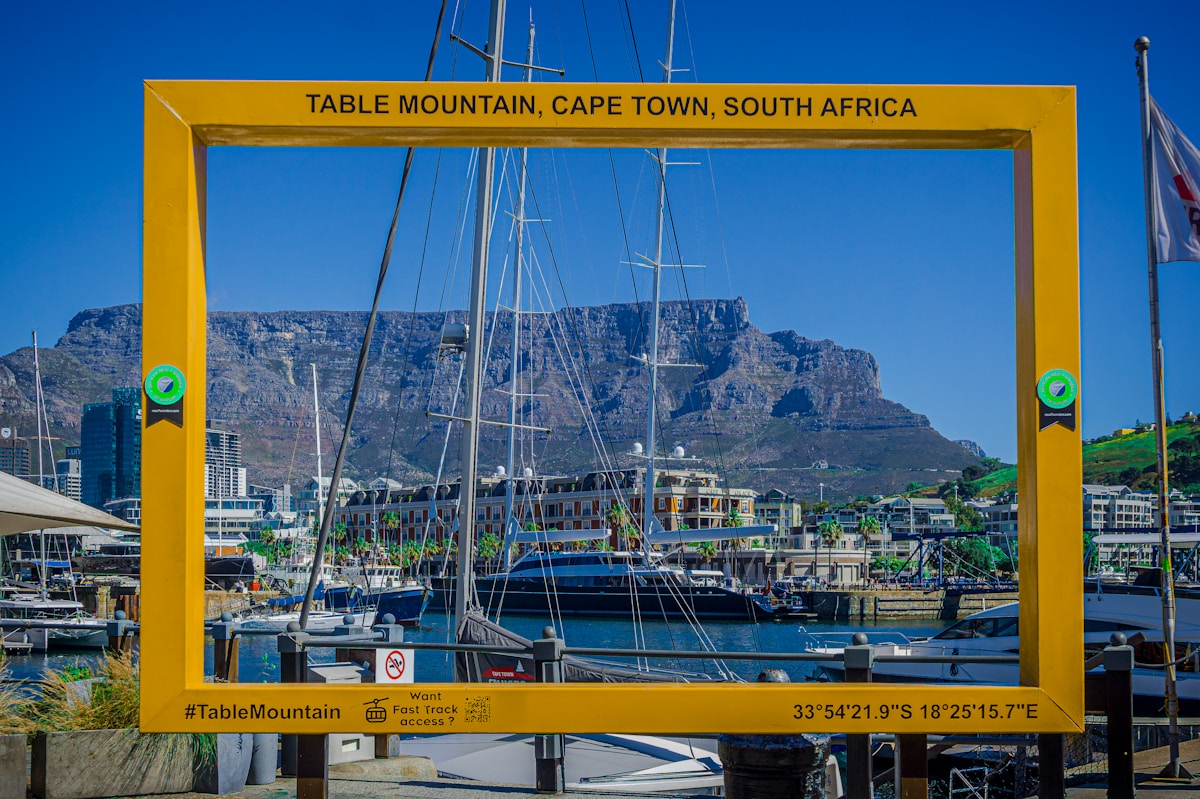
Cape Town is one of the most naturally dramatic cities on Earth. Within 30 minutes of the city centre you can be on a 3,562-metre mountain, watching penguins, swimming at a white-sand beach, or standing at the meeting point of two oceans. The challenge is not finding things to do but deciding what to prioritise.
Table Mountain
The cable car to the top of Table Mountain is Cape Town’s defining experience. The Aerial Cableway rotates as it ascends, giving every passenger a panoramic view as you rise 1,086 metres above the city. At the top, the flat sandstone plateau stretches across a wilderness of fynbos and rock - look west to the Atlantic, north across the City Bowl and harbour, south along the spine of the Cape Peninsula.
Practical details: The cableway runs daily subject to wind conditions. Return ticket approximately R420/adult, R210/child as of 2026. Opening time varies by season - typically 08:30 in summer. Book online in advance during peak season. If the cable car is closed, hiking remains possible on multiple trails; the Platteklip Gorge route takes 2–3 hours to the top.
Tip: Go on a weekday morning. Queues on weekend afternoons in January can exceed 90 minutes. A clear forecast is worth waiting for.
Robben Island
Robben Island sits 11 km off the V&A Waterfront in Table Bay. For 27 years it held Nelson Mandela; before that it served as a leper colony, a military base, and a mental institution. The guided tour - 3.5 hours including ferry - is among the most emotionally affecting heritage experiences in Africa.
The cell-block tour is led by a former political prisoner. Guides share personal accounts of life on the island with a directness that no museum can replicate.
Practical details: Ferries depart from Nelson Mandela Gateway at the V&A Waterfront. Tickets approximately R750/adult as of 2026. Book weeks ahead - tours regularly sell out, especially in summer. The ferry is weather-dependent; carry sea-sickness medication if prone.
V&A Waterfront
The Victoria & Alfred Waterfront is Cape Town’s busiest precinct - a working harbour transformed into a dense cluster of restaurants, bars, the Zeitz MOCAA museum, the Two Oceans Aquarium, and shopping. The Robben Island ferry departs from here, and the Table Mountain cable car is a 15-minute Uber away.
The Zeitz Museum of Contemporary Art Africa (Zeitz MOCAA) occupies the upper floors of a converted grain silo at the Waterfront. It holds the most significant collection of contemporary African art on the continent. Entry approximately R200/adult as of 2026.
The Two Oceans Aquarium is particularly strong for families - the kelp forest exhibit and the penguin feeding sessions are highlights. Entry approximately R280/adult as of 2026.
Bo-Kaap
The Bo-Kaap rises on the slopes of Signal Hill above the city centre. Its cobbled streets and brightly painted houses - vivid pinks, yellows, greens and blues - are among the most recognisable images in South Africa. The neighbourhood is the historic home of Cape Town’s Cape Malay community, and its cultural character remains genuine.
Walk the main streets in the morning before the tour groups arrive. The Bo-Kaap Museum on Wale Street gives context on the history of the Cape Malay people and the architecture of the quarter (entry approximately R30 as of 2026). For Cape Malay food - fragrant koeksisters, curried mince pies, spiced lamb - seek out the small family-run restaurants and takeaways on the main streets.
Cape Peninsula and Cape Point
The Cape Peninsula drive is a half- or full-day excursion from the city. The classic route heads south via Hout Bay, along the Atlantic coast to Cape Point (the southwestern tip of Africa), across to Boulder’s Beach and the penguin colony, then back to Cape Town via the False Bay coast.
Cape Point: Part of the Table Mountain National Park. Entry approximately R353/adult for international visitors as of 2026. The old lighthouse at the top gives views over the confluence of two ocean currents. A funicular (additional charge, approximately R90 return) runs to the lighthouse peak.
Boulders Beach: African penguin colony at Simon’s Town, 45 km south of the city. Entry approximately R205/adult as of 2026 (SANParks rate for international visitors). Arrive early in summer - the car park fills by 09:00. The boardwalk through the colony brings you within a few metres of several hundred penguins.
Practical details: The full Cape Peninsula loop is 150 km from central Cape Town. A hire car gives maximum flexibility (approximately R400–600/day for a small automatic as of 2026). Alternatively, guided half-day and full-day Cape Peninsula tours depart from the Waterfront from approximately R600–900/person.
Chapman’s Peak Drive
Between Hout Bay and Noordhoek, Chapman’s Peak Road is one of the most spectacular coastal drives in the world - nine kilometres of cliff-side road carved into the vertical face of the mountain above the Atlantic. The toll is approximately R45 per car as of 2026.
Kirstenbosch National Botanical Garden
Kirstenbosch sits on the eastern slopes of Table Mountain in Newlands, 13 km from the city centre. The garden covers 528 hectares of Cape fynbos - the most biodiverse flora region in the world per square metre. The Tree Canopy Walkway curves through the forest canopy 10–12 metres above ground.
Entry approximately R220/adult, R30/child as of 2026. The Sunday evening summer concerts (November–April) pack the lawns for picnic performances. Book concert tickets well in advance.
Neighbourgoods Market and Old Biscuit Mill
The Saturday Neighbourgoods Market at the Old Biscuit Mill in Woodstock (09:00–14:00) is Cape Town’s most concentrated food and artisan experience. Around 80 vendors - fresh bakes, craft beer, coffee, charcuterie, cheese, clothing, ceramics. Worth building a Saturday morning around; busy from 10:00 onwards.
Lion’s Head Hike
Lion’s Head is the conical peak that rises above the Atlantic Seaboard, visible from Sea Point, Camps Bay and the Waterfront. The 2–3 hour circular trail from Signal Hill Road is moderate with some steel chain sections on the upper scramble. Start at 07:00 on weekdays to avoid crowds. The sunrise full-moon hike (on the night of the full moon each month) has become a Cape Town ritual - bring a headlamp and book parking early.
District Six Museum
The District Six Museum tells the story of the forced removal of 60,000 Cape Town residents under apartheid’s Group Areas Act. A modest admission charge (approximately R50 as of 2026) covers a deeply personal exhibition built with contributions from former residents. A necessary counterpoint to the natural spectacle of the rest of Cape Town.
Getting Around
Uber: Reliable and well-priced - most inner-city trips cost R50–120. The safest way to travel between attractions, especially after dark.
MyCiti Bus: Fixed-route bus connecting the airport, Waterfront, Sea Point and the City Bowl. Useful for budget travel; service frequency is inconsistent.
Hire car: Essential for the Cape Peninsula and Winelands. Most major rental companies have desks at Cape Town International Airport and the Waterfront. Approximately R400–600/day for a small automatic as of 2026.
Ready to plan? Cape Town city guide for full orientation, 3-day Cape Town itinerary to structure your time, or book tours and activities in Cape Town.
See Also
- Cape Town city guide - orientation, transport and practical info
- Where to stay in Cape Town - hotel picks by area and budget
- Cape Town hotels guide - curated picks across all budgets with booking advice
- Best Cape Town tours - guided options for the Cape Peninsula, Winelands, and city highlights
- Best restaurants in Cape Town - where to eat after a day of sightseeing
- Cape Town beaches - Clifton, Camps Bay, Muizenberg and beyond
- Cape Peninsula day trip - full guide to the Cape Point route
- Table Mountain guide - cable car, hiking routes and tips
- 3-day Cape Town itinerary - how to fit the highlights into three days Search hotels in Cape Town on Booking.com