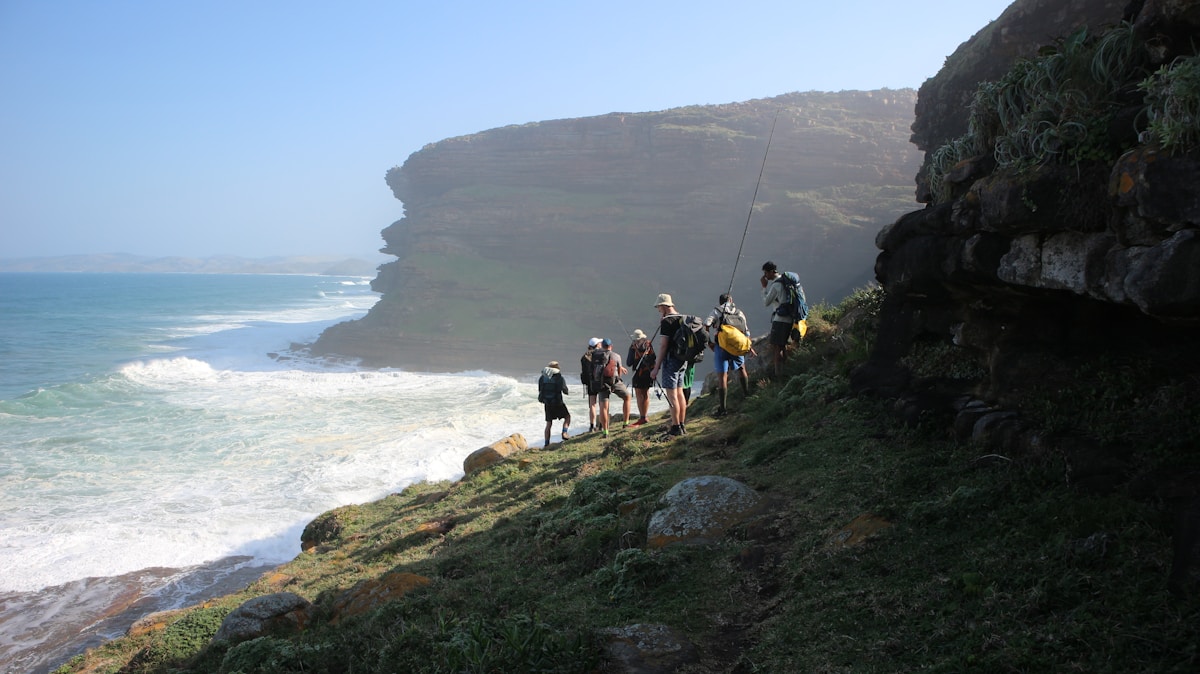
The Wild Coast - 280 km of cliff, river, and beach stretching from the Kei River mouth north to the KwaZulu-Natal border - is the least-developed stretch of South African coastline, and by some distance the most dramatic. No major resort towns, no coastal motorways. What you get instead is a succession of deserted beaches separated by rocky headlands, river estuaries crossable only at low tide, and scattered Xhosa villages where goats outnumber cars.
Coffee Bay is the easiest entry point: a small village with a cluster of backpacker lodges, reliable electricity, and enough infrastructure to plan longer excursions from. But the Wild Coast rewards those who go further - to Bulungula, to the Hole in the Wall, or out onto the hiking trail itself.
Getting There
From East London
East London is the most common gateway. Head north on the N2, then pick up the R61 past Mthatha, following the signs toward Coffee Bay. The total distance is approximately 210 km. The final 30 km on the R61 turnoff become an unpaved but well-graded gravel road - passable in a standard hire car outside of the rainy season. Allow 3 to 3.5 hours, or a little longer after rain. Hire a car at East London Airport (ELS) - compact rates run approximately R400–R600 per day.
If you don’t have a car, Baz Bus runs along the N2 between Port Elizabeth and Durban and drops passengers directly at Coffee Bay backpackers on request - check the current schedule at bazbus.com for up-to-date fares (approximately R600–R900 for the Port Elizabeth–Coffee Bay leg as of 2026).
From Durban
Durban is further but remains a practical starting point, particularly if you’re combining the Wild Coast with a KwaZulu-Natal trip. Take the N2 south through Port Shepstone and into the Eastern Cape, then follow the R61 signs. The total distance to Coffee Bay is approximately 430 km - allow 5.5 to 6 hours of driving. Alternatively, work your way south via Port St Johns first (around 350 km from Durban) before looping to Coffee Bay.
Getting Around Locally
There is no meaningful public transport between Wild Coast villages. The dirt roads connect most towns, but distances are deceiving on rough tracks. If you’re staying in one village and day-tripping, most backpackers can arrange local transfers or guided excursions. A 4x4 or high-clearance vehicle opens up more options after rain.
Coffee Bay
Coffee Bay is the Wild Coast’s most accessible village, named - local legend has it - after a shipwrecked cargo of coffee beans washed ashore in 1878. It sits at the mouth of the Coffee River, with a sheltered beach ideal for swimming and enough cafes and hostels to keep a traveller occupied for several days.
The village itself is small and walkable. The beach runs from the river mouth to a rocky headland; conditions are generally calm enough for swimming from May to September and wilder in summer. Most visitors use Coffee Bay as a base for excursions rather than a destination in itself.
Hole in the Wall
About 8 km south of Coffee Bay by road (or a 2.5-hour coastal hike), the Hole in the Wall is the Wild Coast’s signature landmark: a sheer cliff island standing just offshore, with an arched tunnel large enough for the ocean to thunder through. The Xhosa name, esiKhaleni, means “the place of the sound.” The experience is more elemental than a typical tourist stop - the wave action through the arch is loudest and most spectacular in rough weather.
A basic camping site sits beside the beach. Guides in Coffee Bay run day trips here; expect to pay approximately R300–R500 per person depending on transport. The coastal hike from Coffee Bay is straightforward if tides are checked first - several river crossings are impassable at high water. Browse Wild Coast and Eastern Cape tours on GetYourGuide.
Mdumbi Beach
North of Coffee Bay, Mdumbi is a crescent of sand at the Mdumbi River mouth, arguably the most beautiful beach on this stretch of coast. It’s reachable by a 45-minute walk from Coffee Bay over the headland, or via dirt road. A small community-run guesthouse operates here. Surfers make the trip specifically for the break at Mdumbi Point.
Port St Johns
Port St Johns - or PSJ to anyone who’s been - sits where the Mzimvubu River meets the sea, 90 km north of Coffee Bay by road. It’s the Wild Coast’s largest town, with more infrastructure, more accommodation variety, and a character distinctly its own: part backpacker hub, part local market town.
First Beach is in the town centre and more sheltered. Second Beach, about 3 km south, is where most travellers spend their time - a long, quiet stretch of sand with a few beach shacks and the Jungle Monkey Backpackers at the far end. Third Beach, another 5 km south, is more remote and has had occasional security incidents in the past; ask at your accommodation for the current situation before going.
The Mzimvubu estuary itself is worth a morning - boat trips (approximately R200–R350 per person) run upriver past reed beds full of kingfishers and monitor lizards. Dolphins are common in the river mouth year-round.
Bulungula
Bulungula Lodge, roughly 15 km north of Coffee Bay by dirt road or a section of the hiking trail, is in a different category from the backpacker lodges. It’s a 100% Xhosa community-owned eco-lodge built on land that belongs to the Nqileni village - the community holds the equity. There’s no mains electricity (solar panels and candles), mobile signal is unreliable, and meals are cooked in the communal kitchen.
What the lodge offers instead is one of the most genuine rural experiences available to travellers in South Africa: sunrise swims at the Bulungula River mouth, horse riding on the beach (approximately R350 per hour), canoe trips up the estuary, and evenings around a fire with local staff. Day visitors from the Nqileni village run cultural walks and craft demonstrations.
Rates (approximately, as of 2026): dormitory beds from R450 including dinner, breakfast, and a morning activity. Double rondavels from R1,500 per couple full-board. Book directly at bulungula.com - booking fills months ahead for July and August.
Accommodation on the Wild Coast
Backpackers and Budget
- Coffee Shack (Coffee Bay) - the longest-established backpacker in town. Dorm beds from approximately R380, private doubles from approximately R850. Beach-facing bar, surf board hire, regular braais.
- Bomvu Paradise (Coffee Bay) - quieter alternative, popular with longer-stay travellers. Dorms from R350, doubles from R750.
- Jungle Monkey Backpackers (Port St Johns, Second Beach) - right on the sand. Dorms from R350, doubles from R800. The social hub for Second Beach.
- Amapondo Backpackers (Port St Johns, First Beach) - central location, good mix of dorms and private rooms. From approximately R340/dorm.
Lodges and Mid-Range
- Morgan Bay Hotel (Morgan Bay, south Wild Coast) - an old-style family hotel on the Kei River mouth, approximately R1,600–R2,400 per room half-board. A genuinely peaceful base for the southern Wild Coast.
- Cremorne Estate (Port St Johns) - self-catering cottages set back from Second Beach, approximately R900–R1,600 per night for two. Good option for self-drivers with kitchens.
- Mpande Lodge (near Coffee Bay) - small guesthouse above the beach, approximately R1,200–R1,800 per double B&B. Quieter than the village.
Hiking the Wild Coast Trail
The Wild Coast Hiking Trail runs approximately 56 km from Kei Mouth south to Coffee Bay, traversing headlands, river crossings, and deserted beaches over five days. It’s divided into five day-sections, each ending at a basic trailside overnight hut with cooking facilities and bunk beds but no electricity.
Permits and booking: ECParks (ecparks.co.za) handles all bookings. A permit costs approximately R250 per person per day as of 2026 and includes the hut accommodation. The trail operates daily with a cap of 16 hikers; dry-season dates (May–September) sell out months in advance.
Fitness: The trail is rated moderate. There are no extreme climbs, but the sand and soft ground tire legs quickly, and day sections of 10–15 km with a loaded pack take full days. River crossings at the Mbashe and other estuaries require timing with the tides - the trail notes provided with your permit are essential reading.
Solo hiking: not recommended. The trail passes through remote areas and river crossings require judgement in swells. Most tour operators running guided Wild Coast walks (Hiking Adventures Wild Coast, Untouched Adventures) charge approximately R5,000–R8,000 per person for a fully catered five-day guided trip.
Self-drive logistics: most hikers arrange a shuttle transfer from Kei Mouth to Coffee Bay (or vice versa) at approximately R800–R1,200 per vehicle; Coffee Bay backpackers can organise this.
Cultural Experiences - Xhosa Homestays
The Wild Coast runs through the former Transkei homeland, and the landscape is defined as much by Xhosa culture as by geography. Most backpackers in Coffee Bay and Port St Johns can connect travellers with village visits or longer homestay arrangements through the Nqileni or Mapuzi communities.
Bulungula Lodge runs the most structured community experience - cultural walks with a local guide explain Xhosa customs, homestead architecture (the circular rondavel construction), and the role of the initiation school (ulwaluko) in Xhosa identity, approximately R150–R250 per person. These visits are done with invitation and community consent, not as passive observation.
Broader homestay programmes can be arranged through Reel Gardening or directly with the lodges at approximately R400–R700 per night including meals. Learning a few Xhosa clicks (the lateral click, //hl sound) goes a long way socially.
Safety
The Wild Coast is not comparable to Johannesburg in terms of urban crime. That said, practical caution applies:
- Don’t leave cameras or bags visible in a parked car at trailheads or beach car parks.
- Solo hiking on isolated trail sections carries risk - crime on remote stretches has been reported, though infrequently. Hike with at least one other person.
- Swimming: rip currents are strong at exposed beaches. The eastern SA coast has powerful surf; swim where locals swim, and check with your accommodation about specific beaches.
- Night safety in larger towns (Port St Johns town centre) follows standard urban SA advice - don’t walk alone after dark outside the main tourist cluster.
Best Time to Visit
April to October is optimal. Days are warm (20–26°C), humidity drops markedly after the summer rains, river crossings on the hiking trail are more predictable, and the coastline is drier. June and July bring perfect hiking weather - clear air, cooler nights, and near-empty beaches outside weekends.
November to March is the summer rainy season. Temperatures climb to 28–33°C with high humidity and regular afternoon downpours. Dirt roads can become inaccessible for days after heavy rain; river crossings on the trail can be uncrossable for a week. December and January are the busiest weeks - South African school holiday traffic is heavy and accommodation at well-known spots books out far in advance.
The Wild Coast is malaria-low-risk compared to Kruger or northern KZN - it sits outside the main transmission zones - but tropical conditions in summer mean mosquito protection (repellent, long sleeves at dusk) remains sensible.
Practical Notes
- ATMs are scarce. Coffee Bay has one ATM that frequently runs dry on weekends. Bring sufficient cash from East London or Mthatha.
- Mobile signal is patchy between villages. Download offline maps before leaving the N2.
- Petrol: fill up in Mthatha or East London before heading down the R61 - there’s one small fuel station at Coffee Bay that sometimes runs short on diesel.
- Permit prices and trail availability: verify current rates at ecparks.co.za before planning, as fees adjust annually.
See Also
- Eastern Cape region guide - the Wild Coast in the wider Eastern Cape context
- KwaZulu-Natal region guide - continuing north from Port St Johns along the coast
- Garden Route vs Wild Coast comparison - which coast to prioritise on your itinerary
- Addo Elephant National Park - the other Eastern Cape drawcard, west along the coast
- Is South Africa safe? - honest safety assessment for remote coastal travel
- South Africa car rental guide - essential for reaching the Wild Coast from East London
- 10-day South Africa itinerary - how the Wild Coast fits a longer trip