Search hotels in Kruger National Park on Booking.com
Kruger National Park covers 19,485 km² of savanna, woodland, and riverine forest in South Africa’s Limpopo and Mpumalanga provinces - roughly the size of Wales, or slightly larger than Israel. It was established in 1898 as the Sabi Game Reserve under Paul Kruger’s government, making it one of the oldest game reserves in Africa.
For most visitors, Kruger represents their first encounter with African wildlife. It’s also one of the most accessible major game parks on the continent: tarred roads connect the rest camps, accommodation ranges from camping to comfortable self-catering chalets, and a standard hire car handles everything you need. For the detailed self-drive logistics - driving strategies, camp comparisons, day-by-day planning - see the Kruger self-drive safari guide. This guide focuses on the park’s essentials: what wildlife you can realistically expect to see, when to go, how the entry system works, and what each rest camp offers.
Kruger at a Glance
| Park size | 19,485 km² |
| Established | 1898 (as Sabi Game Reserve) |
| Entry fee - international visitors | R440 per person per day + R204 per vehicle |
| Best time for game viewing | May–September (dry season) |
| Malaria | Yes - entire park is a malaria risk area |
| Driving | Standard hire car on tarred main roads; no 4x4 needed |
| Nearest airport | Kruger Mpumalanga International (KMIA), Nelspruit |
| Drive from Johannesburg | 4–5 hours to Paul Kruger Gate |
The Big Five: Realistic Sighting Probabilities
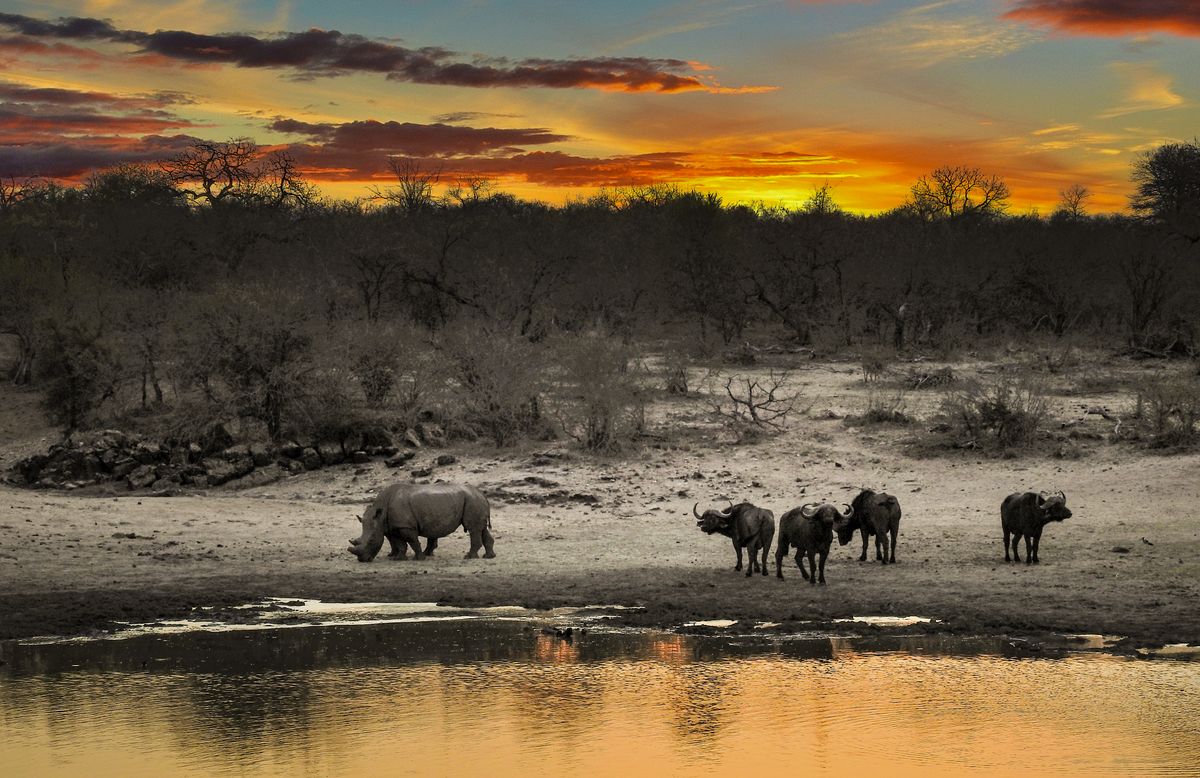
The Big Five - lion, leopard, elephant, buffalo, and rhino - are all present in Kruger. Sighting probability varies significantly by species and depends on which part of the park you drive, the time of year, and how much time you spend.
Elephant
Near-certain. Kruger holds approximately 20,000 elephants, and they move throughout the park. You’re likely to encounter them on your first game drive - at waterholes, along rivers, and often directly on the road. Groups of 20–40 are common. Single males are more unpredictable and should be given a wider berth. Give way, switch the engine off, and wait - they’ll move when ready.
Buffalo
Common. Large herds (hundreds of animals) are frequent in the southern and central park. Buffalo are often close to lion activity - a herd of buffalo in the early morning, particularly on a return from a waterhole, is worth following slowly. Lone old males (dagga boys) are more dangerous than herds; don’t approach them on foot.
Lion
Reliably seen in the southern third of the park with patience. The area between Crocodile Bridge and Lower Sabie, and around Satara camp, holds high lion densities. Finding lions requires time and early mornings - they’re most active at dawn and at dusk. In peak dry season, experienced self-drivers find lions on perhaps 70–80% of days in the southern zones. Less certain in the central and northern park.
White Rhino
Seen regularly in the south, particularly around Berg-en-Dal, Malelane Gate, and the H4-2 road from Crocodile Bridge to Lower Sabie. White rhino are grazers and favour open grassland - easier to spot than black rhino. Black rhino are browsers, nocturnal-leaning, and scarce - an encounter is exceptional.
Leopard
The hardest Big Five species to find reliably. Leopards are present throughout the park but are nocturnal and cryptic. The Sabie River drainage (between Skukuza and Lower Sabie) is the most productive area. Early mornings in the first hour after gates open, driving slowly along drainage lines, gives the best odds. Even experienced safari guides estimate that dedicated leopard watching on specific routes yields sightings on perhaps 40–60% of sessions. A leopard in a tree with a kill is the prize sighting.
Other Notable Wildlife
- Wild dog: Rare but present in central and northern Kruger. Sightings are genuinely memorable.
- Cheetah: Open grassland zones around Satara and Nwanetsi. Less common than lion.
- Hippo: At every major river - Sabie, Olifants, Letaba. Reliable at Crocodile Bridge and Lower Sabie.
- Crocodile: Every river. Largest concentration at Lower Sabie and Crocodile Bridge.
- Giraffe: Present throughout, easier in the taller vegetation of the central park.
- Zebra and wildebeest: Common across the central and southern zones.
Conservation Fees and Entry
International visitors (2025/26 SANParks rates):
- Conservation fee: R440 per person per day (approximately $24 / £19)
- Vehicle fee: R204 per vehicle per visit (one charge for the full stay, not per day)
You pay at any entrance gate on arrival. SANParks operates a digital card system - you’re issued a card that serves as both your entry permit and rest camp access card. Keep it throughout your stay.
Accommodation inside the park is booked and paid separately through the SANParks online reservation system (sanparks.org). Book 3–4 months ahead for dry season (May–September); 6+ months for July–August peak.
Conservation Card Note
The SANParks Wild Card offers unlimited park access for 12 months and is cost-effective for visitors spending 6+ days across multiple SANParks reserves. For a typical 3–5 day Kruger visit, paying per day at the gate is more economical.
Entrance Gates
Kruger has multiple entrance gates along its western and southern boundaries. Choose based on which camps you’re staying at.
Paul Kruger Gate - the most popular entry point, leading directly to Skukuza (the largest camp). Best for first-time visitors who want the southern and central park. About 4.5 hours from Johannesburg via the N4.
Numbi Gate - southwest entry from White River, leading to the Pretoriuskop area. Alternative first entry point if arriving from the N12 direction.
Malelane Gate - southern entry, closest to Berg-en-Dal camp and good rhino country.
Crocodile Bridge Gate - southernmost gate. Excellent game viewing almost immediately on entry - lions and buffalo are frequently encountered in this area. About 5 hours from Johannesburg.
Orpen Gate - central western entry, useful for Satara camp and the lion-rich central zones.
Phalaborwa Gate - northern entry from Limpopo province. Furthest from Johannesburg; most visitors with limited time use the southern gates instead.
Gates open at sunrise and close at sunset. Exact times are posted at each gate and vary by month. Driving after dark inside the park is not permitted - plan your day so you return to camp before closing.
Rest Camps
All rest camps offer accommodation ranging from camping pitches to chalets and family cottages. Rates below are 2025/26 SANParks prices for international visitors.
Skukuza (central south)
The largest camp in the park - more than 300 accommodation units, plus a restaurant, shop, filling station, ATM, swimming pool, and medical clinic. Accessed directly from Paul Kruger Gate. The Sabie River runs along its eastern boundary, making it one of the best camps for early-morning hippo, crocodile, and waterbird watching without leaving camp.
Chalets (4-bed, self-catering): from R2,400/night. Doubles: from R1,200. Camping: from R350. The restaurant operates breakfast, lunch, and dinner - adequate quality and reasonable prices.
Skukuza is the obvious base for southern park exploration. The H4-1 road west to Lower Sabie and the H1-2 north toward Satara are both productive routes.
Lower Sabie (southeast)
50 km southeast of Skukuza on the Sabie River. Smaller and quieter than Skukuza with a well-deserved reputation as the park’s best sighting location - lions, leopards, and cheetahs are all reliably found within the surrounding road network. The H4-2 from here to Crocodile Bridge is consistently one of Kruger’s most productive game drives.
Self-catering chalets: from R1,400/night. River chalets face directly onto the Sabie River - worth the premium. Book 4–5 months ahead in dry season. The camp sells out faster than any other in the park.
Satara (central)
Central Kruger, in open bushveld - structurally one of the best environments for large lion prides. The Gudzani Dam and the road network around Satara (particularly the S100 loop) regularly produce lion, cheetah, and large buffalo herds.
Self-catering chalets: from R1,100/night. Camping: from R350. Facilities include a shop, restaurant, pool, and filling station. The camp is well-run and popular without being overwhelming.
Berg-en-Dal (south)
Southwest of Malelane Gate, on the Malelane mountain bushveld. Excellent white rhino sightings - the approach roads and the H3 south from here are consistently productive for rhino. The camp sits in a valley with good wildlife around the perimeter fence at night.
Self-catering chalets: from R900/night. Family-friendly with a good swimming pool. The dam below the camp produces good general wildlife at dawn.
Olifants (central north)
Dramatically positioned on a rocky cliff above the Olifants River, Olifants camp is one of the most scenically striking in the park. Views from the restaurant terrace across the river floodplain are exceptional at any time of day. Good elephant and hippo sightings in the river below.
Self-catering chalets: from R1,200/night. More remote than the southern camps; the surrounding road network is less consistently productive for big cats, but the scenery and sense of solitude are worth it.
Letaba (north)
Further north, on the Letaba River. Excellent elephant habitat - the Elephant Hall at Letaba displays the tusks of the Magnificent Seven, Kruger’s famous large-tusked bull elephants. The Olifants River road west of camp is good for elephant and buffalo.
Chalets from R1,100/night.
Best Time to Visit
Dry Season (May–October)
The optimal period for wildlife viewing. As water sources dry up, animals concentrate at permanent rivers and artificial waterholes - making sightings more predictable and views clearer through the thinning vegetation.
- May–June: Dry season establishes. Comfortable temperatures (18–28°C). Less crowded than July–August.
- July–August: Peak visitor season. Maximum game activity but maximum crowds. Book accommodation 6+ months ahead.
- September–October: Still excellent. Vegetation at its lowest. Hot days (32–38°C) but productive early mornings.
Wet Season (November–April)
The green season transforms the park. Disadvantages: denser vegetation obscures animals; some gravel roads close after heavy rain; mosquito activity is higher (malaria precautions essential). Advantages: dramatically lower accommodation costs, no crowds, newborn calves and cubs (good predator activity around vulnerable young), and exceptional birding - summer migrants including rollers, bee-eaters, and raptors arrive October–November.
October–November is widely considered an underrated period - game viewing is still reasonable (vegetation not yet fully established), birding is outstanding, and prices are below peak.
Guided Safaris in the Park
Self-drivers can access all the main roads and rest camps. For guided experiences inside the park:
Morning game drives - depart from rest camps at dawn, return by mid-morning. Approximately R550–700 per person. Led by SANParks rangers in open vehicles.
Night drives - after-dark drives from camp in open vehicles, using spotlights. Night drives reveal nocturnal species invisible to daytime visitors: civets, large-spotted genets, aardvarks (occasionally), scrub hares, and the chance of lion on a nocturnal hunt. Approximately R500–650 per person.
Bush walks - 3-hour guided walks with two armed rangers. One of the most intense wildlife experiences available in Kruger - moving on foot through the bush with a professional ranger. Maximum 8 participants. Approximately R600–750 per person. Book in advance at rest camps.
How to Get There
By Air
Fly from Johannesburg OR Tambo to Kruger Mpumalanga International Airport (KMIA) near Nelspruit/White River. Flight time: approximately 1 hour. Airlink operates this route with multiple daily departures. Hire a car at KMIA - Avis, Budget, and Europcar all have desks. Drive time from KMIA to Paul Kruger Gate: approximately 1 hour.
Tip: Flying in and self-driving is the most efficient approach for a 3–5 day Kruger visit.
By Road
From Johannesburg to Paul Kruger Gate via the N12 and N4 through Middelburg and Nelspruit: 4–5 hours depending on traffic and pace.
From Pretoria: approximately 4 hours.
Most self-drivers from Johannesburg combine the drive with a stop at the Panorama Route along the Drakensberg escarpment - Blyde River Canyon (the third-largest canyon in the world) and God’s Window - adding 2–3 hours but worth the detour. Enter Kruger through Numbi or Paul Kruger Gate after the Panorama stops.
What to Bring
Binoculars - essential, not optional. 8x42 or 10x42. Animals at distance, birds in trees, identifying species before you get close.
Camera with a long lens - 300mm minimum, 400–600mm for bird photography. Most wildlife shots are taken at distance through a car window.
Clothing - neutral colours (khaki, olive, grey, tan). Not camouflage (illegal in some parks) and never bright colours. Layers for early mornings (cold in June–July, even in the subtropics at 05:30).
Malaria prophylaxis - consult a GP 4–6 weeks before travel. Malarone is the most commonly used for short stays. Doxycycline is cheaper. Start taking before your arrival date as prescribed. Travel insurance covering medical evacuation is recommended - emergency transport from Kruger to a major hospital is expensive without it.
DEET repellent - apply at dusk and dawn. Keep windows closed or use the provided mosquito nets at rest camps.
Water and snacks - take food and water for every drive. Rest camps sell supplies, but stops are limited in the field. Picnic sites at designated points allow you to get out of the car.
Field guides - Sasol Birds of Southern Africa and Newman’s Birds are the standard references. The SANParks app (free) provides maps and road status.
Next Steps
- Kruger self-drive guide - gate logistics, driving strategies, road-by-road Big Five tips
- Best Kruger tours - guided safari options from Johannesburg and Pretoria, with prices and operator comparisons
- Where to stay for Kruger - rest camps, private lodges, and budget options near the gates
- 5-day Kruger itinerary - day-by-day plan with specific route recommendations
- Mpumalanga region guide - Panorama Route, accommodation outside the park, private lodge comparison
- Health and vaccinations - full malaria prophylaxis detail
- 14-day South Africa itinerary - how Kruger fits into a complete SA trip
- Last-minute tours - same-day and next-day safari availability if your trip dates are already locked in
- Kruger vs Addo - if you’re deciding between Kruger and the malaria-free Eastern Cape option