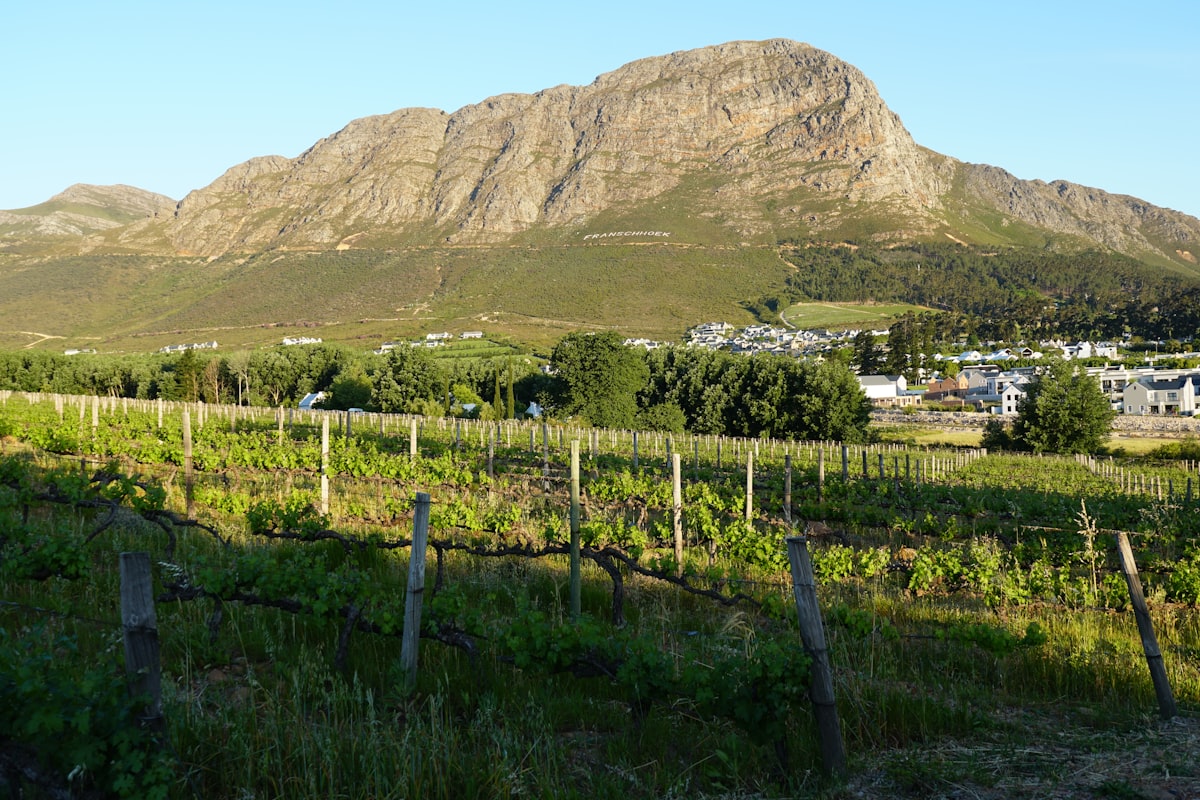
Franschhoek occupies a narrow valley about 80 km east of Cape Town, enclosed on three sides by the steep Franschhoek Mountains. The valley floor is covered almost entirely in vines. There is a single main street, a disproportionate number of restaurants that would hold their own in any major city, and an unhurried pace that makes it easy to spend far longer here than planned.
The town’s character is shaped by two things: the French Huguenot refugees who settled here in the late 1600s and planted the first vines, and the chefs and winemakers who arrived in the following decades and built what is now arguably South Africa’s most culinarily ambitious small town. The street names, the estate names, and the architecture all carry traces of that French origin - Franschhoek means “French Corner” in Afrikaans. For where to stay, from estate cottages to boutique hotels, see our Franschhoek accommodation guide.
Getting There
Franschhoek is 75 km from Cape Town and 30 km from Stellenbosch. Self-drive takes about an hour from Cape Town via the N1 and R45 (not R310 - that goes to Stellenbosch). There is no public bus service. Wine tours from Cape Town that include Franschhoek typically run for a full day and cover two or three valleys; GetYourGuide has multiple options from approximately R950 per person.
The most scenic approach is via the Franschhoek Pass from the R321, especially if you are coming from the Overberg direction.
Franschhoek Wine Tram
The Wine Tram is Franschhoek’s best-known attraction and a genuinely good way to cover the valley’s estates without a designated driver. Trams and hop-on hop-off buses run on several routes covering different parts of the valley, stopping at estates where you can taste, have lunch, and rejoin a later tram.
Day passes cost approximately R300 per person (tram only) or R380 with included tastings at selected estates (as of 2026). Booking is essential - the tram sells out well in advance on weekends and during peak season (October to April). Book directly at the Wine Tram website or through the estates.
Routes rotate by day of the week. The Blue and Red routes cover the main valley estates; the Tuk-Tuk route accesses steeper estates not accessible to the tram. Most visitors choose one route and spend four to five hours on it with two or three estate stops.
Top Estates to Visit
La Motte - One of the best-equipped estates in the valley, with a museum dedicated to Cape Dutch art and culture alongside the winery. The Pierneef à La Motte restaurant is one of the most reliable lunch spots in Franschhoek. Tastings from approximately R150 per person; museum included.
Grande Provence - An 18th-century Cape Dutch homestead with contemporary art galleries integrated into the farm buildings. The Angels Tears range offers accessible entry-level wines; the Grande Provence flagship wines are more serious. Tastings from approximately R130 per person.
Boschendal - Strictly speaking in the Drakenstein Valley on the Franschhoek Pass road rather than in Franschhoek itself, but every visitor to the area ends up here. The farm has been producing wine since 1685 and the architecture - long white Cape Dutch manor house, oak-lined avenue - is among the most photographed in the Winelands. Picnic lunches on the lawn run from approximately R320 per person (book ahead). Tastings from approximately R120.
Plaisir de Merle - Strong on Cabernet Sauvignon and Merlot, with a more laid-back atmosphere than some of the showier estates. Less crowded on weekends.
Babylonstoren - About 20 km from Franschhoek on the R45 but worth the detour. The farm garden is extraordinary - eight acres of Cape flora, edible plants, and structured beds that you can walk through. The Babel restaurant does long, leisurely lunches sourced almost entirely from the garden. Book months ahead.
Huguenot Heritage
The Huguenot Memorial Museum at the top of Huguenot Street documents the arrival of French Protestant refugees in the Cape Colony following the 1685 Edict of Fontainebleau, which revoked the rights of Huguenots in France. About 200 Huguenots eventually settled in what became Franschhoek, bringing with them expertise in vine cultivation that shaped the entire Cape wine industry.
Entry is approximately R50 per adult (as of 2026). The main museum covers the Huguenot history and the early Cape Colony, while the smaller annexe houses the genealogical archives used by descendants tracing family trees. The Huguenot Memorial - a white marble monument with three female figures representing Liberty, the Arts, and the Faith - stands at the top of the main street.
Admission also covers the adjacent Jean du Buisson house, a restored 18th-century Cape Dutch home furnished as it would have been during the colonial period.
Where to Eat
Franschhoek punches far above its weight for a town of around 35,000 people. The concentration of high-quality restaurants along and around Huguenot Street rivals anything you will find in central Cape Town.
La Petite Colombe - Consistently one of the top five restaurants in South Africa, housed on the Leeu Estates property. The tasting menu runs to seven or eight courses at approximately R1,350 per person (as of 2026, excluding wine pairing which adds approximately R450). This is the special-occasion restaurant in Franschhoek - book two to three months ahead for weekend tables. The cooking is technically accomplished French-South African fusion with outstanding attention to local produce.
Foliage - Chef Chris Erasmus’s restaurant on Huguenot Street focuses on foraged and indigenous ingredients. Smaller and more intimate than La Petite Colombe, with a similarly committed approach to the Franschhoek terroir. Tasting menu approximately R1,100 per person. Booking essential.
Reuben’s - Reuben Riffel’s flagship restaurant on the main street is the most accessible of the fine-dining options. More à la carte in approach than La Petite Colombe’s tasting-menu format, with dishes like duck confit, braised short rib, and Cape Malay-influenced fish dishes from approximately R180–R280 per main (as of 2026). A good option if you want serious cooking without the full tasting-menu commitment.
Ryan’s Kitchen on Reservoir Street Lane - a more relaxed neighbourhood option with a chalkboard menu and a good wine list at reasonable prices. Mains from approximately R160.
Bread & Wine Vineyard Restaurant at Moreson Farm - reliably good wood-fired cooking in a farmhouse setting. Lunch only. Charcuterie platters and pizzas make it a good mid-day stop between estate visits.
Where to Stay
Franschhoek has a higher density of good accommodation relative to its size than almost anywhere in South Africa.
Search hotels in Franschhoek on Booking.com
Budget - from approximately R700/night: Self-catering cottages and B&Bs on the outskirts of town represent the best value. Akademie Street Boutique Hotel has clean, comfortable rooms from approximately R900/night in a central location.
Mid-range - R1,500 to R3,500/night: The Franschhoek Boutique Hotel on Huguenot Street has well-appointed rooms and good proximity to restaurants. Leeu House, part of the Leeu Estates group, offers boutique rooms in a restored Victorian house with access to the same La Petite Colombe restaurant.
Luxury - from approximately R5,000/night: Le Quartier Français is one of the most celebrated small hotels in South Africa - a whitewashed property on Huguenot Street with individually designed rooms and an excellent in-house restaurant (The Werf, lunch and dinner). La Residence, set on a 30-acre estate on the edge of town, offers 11 suites with mountain views and full hotel service.
On-estate stays: Several wine estates offer guest accommodation. Babylonstoren’s farm cottages and the Leeu Estates properties at either end of the main street are the most popular options for visitors who want to wake up in the vineyard.
What Else to Do
Franschhoek Motor Museum at L’Ormarins estate houses around 380 historic vehicles from the 1890s onwards - one of the finest private car collections in the southern hemisphere. Entry approximately R200 per adult (as of 2026). The collection rotates by era throughout the year.
Mont Rochelle Nature Reserve above the valley offers horse trails and hiking with panoramic views of the valley and surrounding mountains. The reserve is accessed from the Mont Rochelle Hotel property.
Cycling: The valley floor is relatively flat and the roads through the estates are well-suited to cycling. Several operators rent bikes from the town centre; expect to pay approximately R200–R300 per day.
Combining Franschhoek with Stellenbosch
The two Winelands towns are 30 km apart on the R310/R45 and make a natural combination for a two- or three-day wine country trip. Stellenbosch has a larger town centre and a wider range of budget accommodation; Franschhoek has the edge for restaurants and drama of setting. Many visitors base themselves in one and day-trip to the other. A Cape Town to Franschhoek to Stellenbosch route is an easy loop on a longer Western Cape trip.