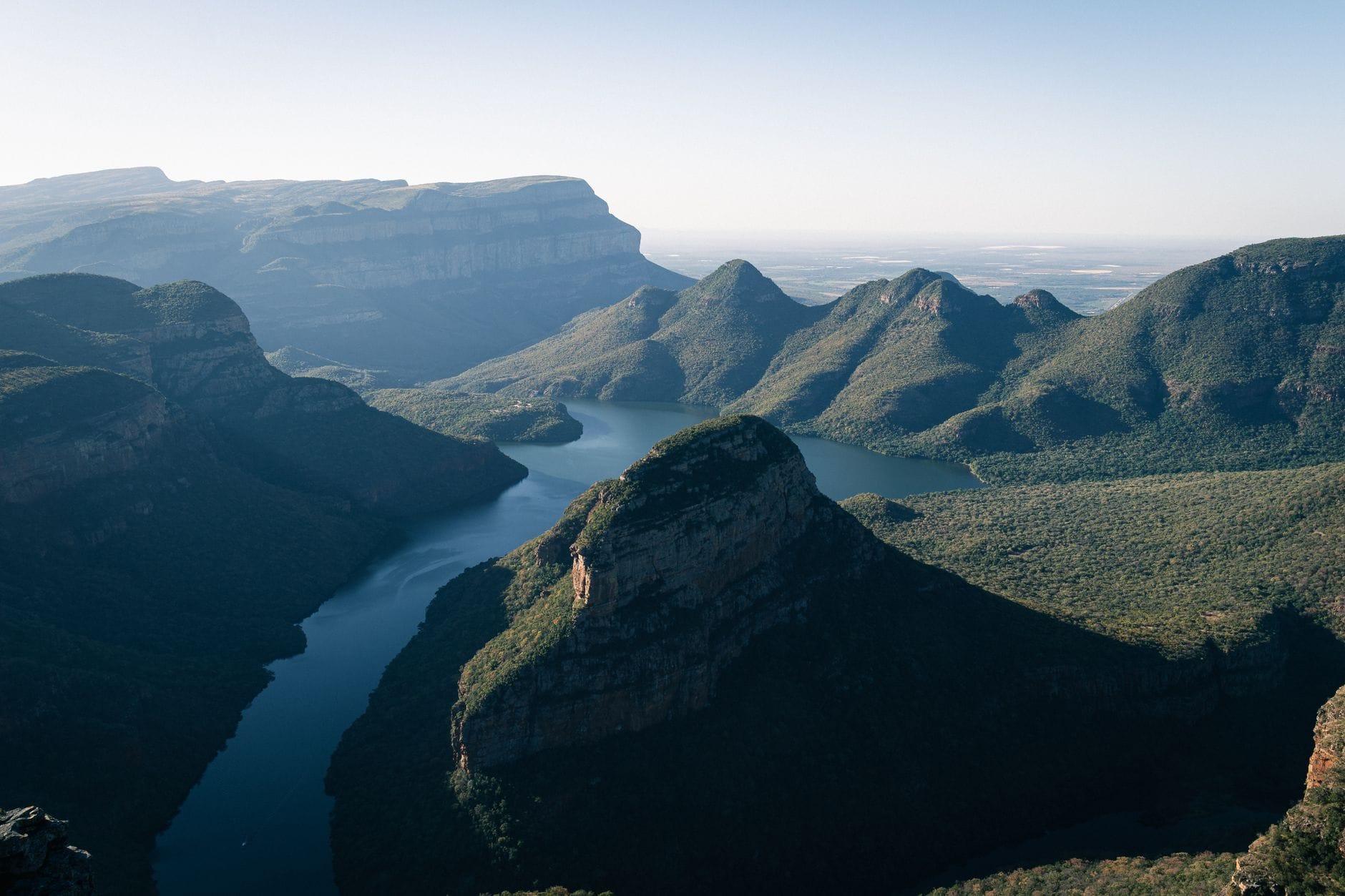
The Panorama Route is a 100 km scenic drive in Mpumalanga that takes in some of the most dramatic cliff-edge scenery in sub-Saharan Africa. The centrepiece is the Blyde River Canyon — the third largest canyon in the world by volume, and by some margin the greenest, with subtropical vegetation covering its 800 m walls above a river that winds through the canyon floor. The drive also passes God’s Window, Bourke’s Luck Potholes, the Three Rondavels, and the old mining town of Pilgrim’s Rest, all within a loop that connects back to Johannesburg in a long day.
The highlights, in order
God’s Window sits at the escarpment edge at 1,730 m — on a clear day you see the full Lowveld spread below, extending on good visibility days as far as Mozambique. The viewpoint is a short walk from the car park through a cloud forest trail. Entry is approximately R100 per adult (2026). Mist is common in the mornings — if you have a choice, arriving mid-morning rather than at sunrise often gives clearer views.
Bourke’s Luck Potholes are at the confluence of the Blyde and Treur rivers. The potholes are cylindrical holes carved into rock by swirling water action — up to 6 m across and several metres deep, filled with emerald-green water. The site has good walking paths, toilets, and a visitor centre. Entry approximately R120 per adult (as of 2026). Allow 45 minutes here.
The Three Rondavels viewpoint looks across the Blyde River Canyon to three cylindrical cliff formations that resemble traditional round houses. The standard photo of the Blyde Canyon is taken from here. No entry fee for the viewpoint — it is on the roadside above the canyon.
Blyde River Canyon Nature Reserve itself covers 29,000 hectares. The canyon is not accessible from the bottom by road — the views are all from the rim, which makes the Panorama Route a drive-and-stop experience rather than a descent into the canyon.
Pilgrim’s Rest is a restored Victorian gold-mining town, declared a national monument. The whole town is essentially a museum — the corrugated-iron buildings are preserved as they stood during the 1870s gold rush. It has a few restaurants and craft shops. Worth 90 minutes if you are interested in the history; easy to skip if you are tight on time.
Tours from Johannesburg
Most Johannesburg-based tour operators offer full-day Panorama Route tours. A typical itinerary departs Johannesburg at 05:30–06:00, reaches the escarpment by 09:00, works through God’s Window, Bourke’s Luck, the Three Rondavels, and optionally Pilgrim’s Rest, and returns to Johannesburg by 19:00–20:00. Some tours combine the Panorama Route with a morning game drive in Kruger — these are very long days (18+ hours) and suit people with specific wildlife goals.
Afrique du Sud Travel and Springbok Atlas are among the established operators running this route. Group day tours typically cost approximately R1,800–R2,400 per person including transport, guided commentary, park entry fees, and lunch. Private tours from Johannesburg run from approximately R3,500 per person for a group of two.
From Hazyview or White River (towns near Kruger’s Phabeni Gate), the Panorama Route is significantly shorter — these towns are approximately 40 minutes from Bourke’s Luck. If you are already based in Mpumalanga for a Kruger stay, the Panorama Route makes sense as a standalone day activity.
For a full selection of operators and to compare prices, browse Panorama Route tours on GetYourGuide.
Self-driving the Panorama Route
This route is well-suited to a self-drive — the R532 and R534 are tarred and well-signed, and the stops are clearly marked. The most logical direction is from Graskop westward (from Johannesburg this means driving to Graskop first via the R40 or N4, then heading north on the R532).
Graskop to Bourke’s Luck Potholes: 35 km, approximately 45 minutes of driving not counting stops. God’s Window is on the R534, a short detour from Graskop.
Bourke’s Luck to the Three Rondavels viewpoint: Continue north on the R532 for 11 km.
Fuel: Fill up in Graskop or Hoedspruit — there are no fuel stations in the canyon section of the route.
Estimated full loop from Johannesburg: 680 km round trip via the N4. Allow 12–14 hours including stops. Departing before 05:30 is advisable to arrive at God’s Window before cloud burns off.
Combining with Kruger National Park
Many visitors use the Panorama Route as a natural add-on to a Kruger safari — both are in Mpumalanga and the distances overlap. Kruger’s western boundary runs roughly parallel to the escarpment, approximately 60 km east of the canyon.
If you are spending two nights near Kruger, a logical itinerary is: Day 1 morning game drive in Kruger → Day 1 afternoon rest → Day 2 Panorama Route day trip → return to Johannesburg on Day 2 evening.
Operators based in Hazyview and Nelspruit often combine morning Kruger drives with afternoon Panorama Route stops — confirm the itinerary carefully as some are rushed.
What to pack
- Layers: The escarpment at 1,700+ m is significantly cooler than Johannesburg and can be cold in the morning even in summer.
- Waterproofs: Cloud and mist at the escarpment edge are common — a light waterproof jacket is useful even in dry season.
- Binoculars: Optional but useful — the Three Rondavels and canyon floor are far away.
- Cash: Some viewpoints and smaller entry points are cash-only. Carry R500 in small notes.
Practical notes
- Entry to the individual viewpoints is managed by SANParks and by Mpumalanga Tourism. Prices quoted above are 2026 estimates — confirm current fees on the SANParks website before travel.
- God’s Window and Bourke’s Luck Potholes both have ablutions and car parks. The Three Rondavels viewpoint is roadside — no facilities.
- Pilgrim’s Rest is on the R533 south of Graskop. If including it, allow an extra 90 minutes.
- Cell reception is good on the R532 and R534. Google Maps navigation works throughout.
- The route is not suitable for very large motorhomes on the Graskop to Blyde River section — some bends are tight.
The Panorama Route is one of those South African experiences that consistently surprises even seasoned travellers. The scale of the Blyde River Canyon is hard to anticipate from photos — standing at the rim gives a physical sense of depth and space that photographs rarely capture. As a day out from Johannesburg, it is unmatched for scenic return per kilometre driven.