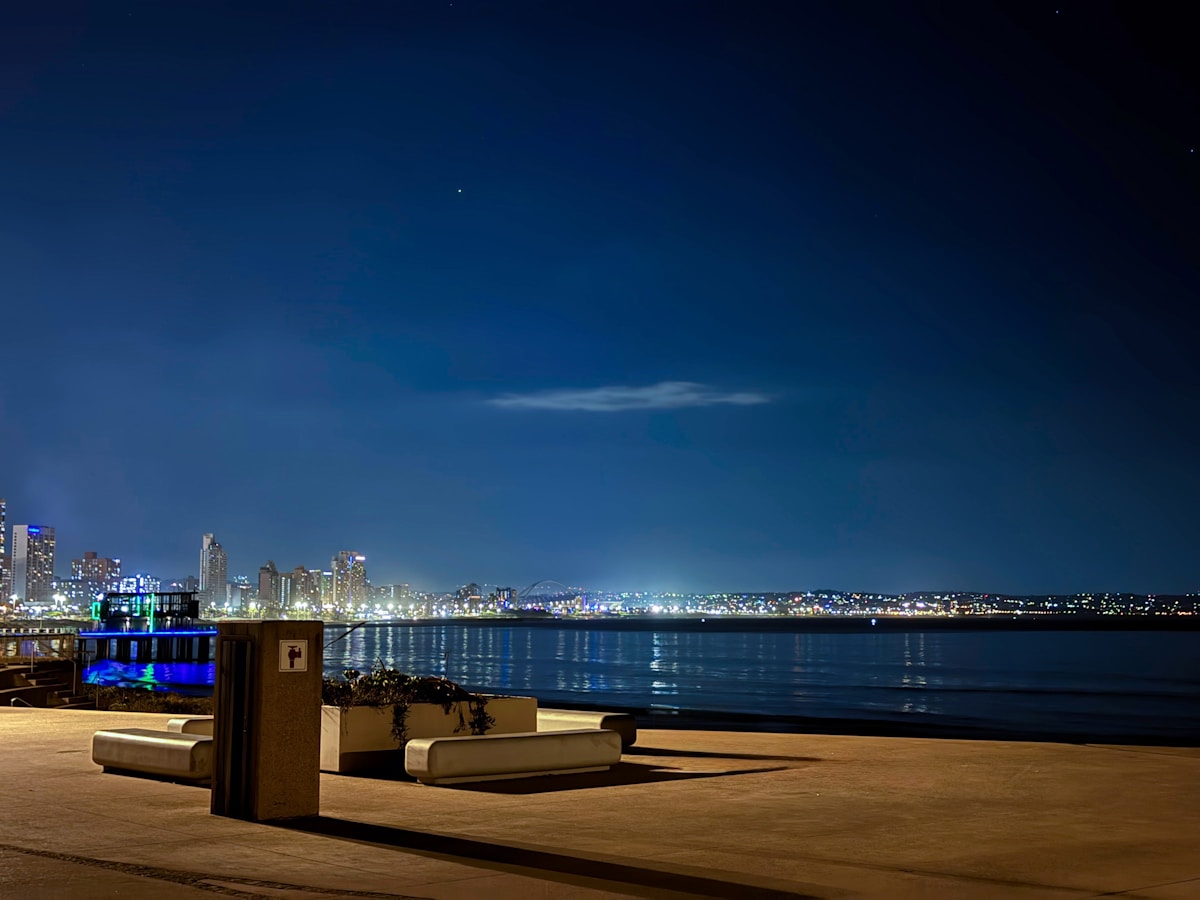
Durban and Cape Town are South Africa’s most-visited cities after Johannesburg - and they’re about as different as two South African cities can be. Cape Town has the mountain, the winelands, the Atlantic. Durban has year-round warm water, the world’s best bunny chow, and an Indian Ocean energy unlike anywhere else in the country. The question isn’t which city is “better.” It’s which city suits your trip.
Quick Verdict
| Factor | Durban | Cape Town |
|---|---|---|
| Setting | Indian Ocean beachfront | Mountain, ocean, winelands |
| Beach weather | Year-round warm (22–28°C) | Best Oct–Apr (Atlantic, colder) |
| Cost | Lower - 15–25% cheaper than CT | Higher, especially accommodation |
| Food scene | World-class curry; moderate variety | Excellent variety; fine dining hub |
| Activities | Surf, water sports, Valley of 1000 Hills | Hiking, wine tasting, Cape Peninsula |
| Cultural identity | Indian-African-Zulu fusion | Cape Malay, Dutch colonial, cosmopolitan |
| International flights | Limited - connect via JNB usually | Direct flights from Europe and beyond |
| Family-friendliness | Strong - uShaka Marine World, beach | Strong - Boulders Beach, aquarium |
Bottom line: Cape Town for mountain-meets-coast drama and the winelands. Durban for beaches, curry, and authenticity without the tourist premium.
Setting and Vibe
Cape Town sits at the foot of Table Mountain between the Atlantic and False Bay. The combination of mountain, ocean, and winelands within an hour’s drive gives it a density of scenery unmatched anywhere in Africa. It’s also more overtly touristy - the V&A Waterfront is busy year-round, Clifton beach umbrellas cost money, and mid-range accommodation books up fast in high season.
Durban is subtropical, chaotic in the best way, and under-toured by international visitors. The Golden Mile beachfront runs for several kilometres of Indian Ocean sand. The city centre’s architecture mixes Victorian British, Mughal-influenced mosques, and Art Deco. Victoria Street Market is one of the great spice markets in the southern hemisphere. Outside the city, the Valley of 1000 Hills and the Drakensberg foothills are within two hours.
Beaches
Durban: Warm Indian Ocean water (22–28°C year-round). The Golden Mile - Ushaka to Blue Lagoon - is cleaned daily and has lifeguards. Shark nets are maintained (South African Shark Board). North Beach and Bay of Plenty are the best surf spots. Umhlanga, 20 minutes north, offers cleaner sand and slightly fewer crowds.
Cape Town: Atlantic beaches (Clifton, Camps Bay, Llandudno) are dramatically beautiful but cold - water temperature averages 12–17°C year-round. Boulders Beach (False Bay side, R240 entry as of 2026) is warmer at 18–22°C and the location of the African penguin colony. If swimming in warm water matters to you, Durban is the clear choice.
Accommodation
Cape Town:
- Budget: Once In Cape Town - dorms from R350/night (US$19) in Green Point
- Mid-range: Atlantic Point Backpackers or De Waterkant guesthouses - R1,500–R2,800/night (US$82–US$154) as of 2026
- Splurge: The Silo Hotel, V&A Waterfront - rooms from R12,000/night (US$660)
Search hotels in Cape Town on Booking.com
Durban:
- Budget: Happy Hippo Backpackers, Glenwood - dorms from R250/night (US$14)
- Mid-range: Garden Court Marine Parade - R1,200–R1,800/night (US$66–US$99)
- Splurge: The Oyster Box, Umhlanga - from R6,500/night (US$357), colonial-style, beachfront
Search hotels in Durban on Booking.com
For a full breakdown by area - Umhlanga, the Golden Mile, and Berea - see our Durban hotels guide or our dedicated where to stay in Durban guide.
All prices are approximate as of 2026 and vary significantly by season.
Food
Cape Town: One of Africa’s best food cities by any measure. Afternoon tapas at the Old Biscuit Mill, seafood at Harbour House, tasting menus at La Colombe (reserve well in advance, from R1,800/person, US$99) - the variety is exceptional. The Bo-Kaap neighbourhood serves Cape Malay cooking unlike anywhere else. Even casual eating is strong: sourdough bakeries in Sea Point, woodfire pizza in Gardens.
Durban: The curry scene is world-class and extremely affordable.
- Bunny chow (curry-filled loaf of bread) - from R55–R85 (US$3–US$5) at Sunrise Chip & Ranch
- Biryani at Victoria Street Market - from R80–R130 (US$4–US$7)
- Spice Emporium, Overport - excellent sit-down Indian; mains from R120–R200 (US$7–US$11)
- Cafe 1999 - upscale Indian fusion, mains from R180–R280 (US$10–US$15)
If you’re prioritising food variety and fine dining, Cape Town wins. If you specifically want exceptional curry at low prices, Durban wins outright.
Activities and Sightseeing
Cape Town highlights:
- Table Mountain cable car - R490/adult return (US$27), pre-book online
- Cape of Good Hope - R404/person international visitor as of 2026 (part of Table Mountain National Park)
- Robben Island ferry and tour - R880/adult (US$48)
- Cape Winelands day trip (Stellenbosch, Franschhoek) - wine tasting from R120–R250/flight as of 2026
- Boulders Beach penguins - R240/adult (US$13)
Durban highlights:
- uShaka Marine World - R295/adult (US$16)
- Valley of 1000 Hills day tour - R800–R1,200 (US$44–US$66) including guide
- Victoria Street Market - free to browse; budget R200–R500 for purchases and food
- Hluhluwe-iMfolozi Park - 3 hours north; R444/adult entry as of 2026 (Big Five, rhino stronghold)
- Drakensberg day trip from Durban - R1,000–R1,500/person for guided day trips
Browse tours and activities in Durban - including Hluhluwe day safaris, uShaka Marine World, and the Valley of 1000 Hills. For logistics, operator picks, and drive times, see our Durban day trips guide.
Entry fees quoted are 2025/26 rates for international visitors and may be updated annually by SANParks.
Getting Around
Cape Town: Excellent for self-drivers. The MyCiTi bus connects the CBD to the Waterfront and Sea Point. Airport is 25 minutes from the city centre by taxi (R350–R450, US$19–US$25). Uber is reliable and safe in tourist areas.
Durban: Uber works well in the northern suburbs and Golden Mile. The CBD is best by taxi or Uber rather than walking. King Shaka International Airport is 35 km north of the city - transfer takes 35–45 minutes; Uber costs R350–R500 (US$19–US$27) depending on traffic.
Cost Comparison
Daily budget (per person, mid-range):
- Cape Town: R2,000–R3,500 (US$110–US$192)
- Durban: R1,500–R2,500 (US$82–US$138)
Durban is consistently 15–25% cheaper than Cape Town across accommodation, restaurants, and activities. The exception is safari day trips - Hluhluwe from Durban costs roughly the same as similar trips from Cape Town.
Durban vs Cape Town for Families
Both cities work well for families - but they reward different priorities.
Cape Town with kids:
- Boulders Beach penguins (R240/child, penguin colony accessible from the car park)
- Two Oceans Aquarium at the V&A Waterfront - R230/child, R310/adult as of 2026
- Cape Point and the Cape of Good Hope National Park - baboons, ostriches, and dramatic coastal scenery; entry R404/adult, under-12 free
- Boulder-based beaches on False Bay (Muizenberg, Fish Hoek) are calm and warmer than the Atlantic side
- Table Mountain cable car takes children from age 2 - under-4 free, under-12 R245 as of 2026
Cape Town’s Atlantic side beaches (Clifton, Camps Bay) are spectacular but cold and can have strong surf. For young children, the False Bay beaches are the better swimming option.
Durban with kids:
- uShaka Marine World - one of Africa’s largest aquariums combined with a waterpark; R295/adult, R215/child as of 2026. Full-day attraction suitable from toddlers upward
- Golden Mile beachfront - warm Indian Ocean swimming year-round (22–28°C), lifeguarded beaches, safe for young children
- Ushaka is a contained, walkable complex that suits families with younger children better than Cape Town’s spread-out attractions
- Valley of 1000 Hills - cultural village experiences with wildlife including giraffes accessible to all ages; guided day tours from approximately R800/adult
The family verdict: Cape Town offers more variety for older children (teenagers especially). Durban is the simpler choice for young children - the warm beach is the activity, the city is compact, and uShaka alone fills a day. If malaria is a concern for the wider trip, note that both cities are malaria-free; it’s only when you travel to Kruger or northern KZN that it becomes relevant.
Best For
Choose Cape Town if:
- This is your first trip to South Africa
- Mountain hiking, winelands, and scenery are priorities
- You want a city with strong international infrastructure
- You’re on a shorter trip (Cape Town rewards 4–5 days)
Choose Durban if:
- Warm ocean swimming is non-negotiable
- You love curry and street food
- Budget is a serious factor
- You’re combining with Kruger or the Drakensberg
Many travellers do both - fly Cape Town → Durban and exit via Johannesburg (or vice versa), giving a three-city sweep of South Africa’s very different personalities.
See also: Cape Town city guide, Durban city guide, Johannesburg city guide, and our Cape Town vs Johannesburg comparison. For the best time to visit either city, see our best time to visit South Africa guide.
Ready to plan your trip? Tours & Activities in Cape Town, Tours & Activities in Durban, Car Hire in Cape Town, or Travel Insurance for South Africa.
See Also
- Cape Town city guide - what to do, where to stay, transport
- Durban city guide - beaches, Indian Quarter, and the Golden Mile
- KwaZulu-Natal region guide - what Durban connects you to in the province
- Western Cape region guide - what Cape Town connects you to in the province
- 14-day South Africa itinerary - how both cities fit into the classic SA circuit
- Garden Route vs Wild Coast - another key SA route comparison for the trip beyond Cape Town
- Kruger vs Pilanesberg - malaria-free safari from Johannesburg vs the flagship park
- South Africa vs Kenya safari - if you’re still deciding which African safari destination to choose
Plan Your Trip
✈️ Book your flights to South Africa 🛡️ Get travel insurance 📱 Stay connected with an eSIM 🚗 Rent a car