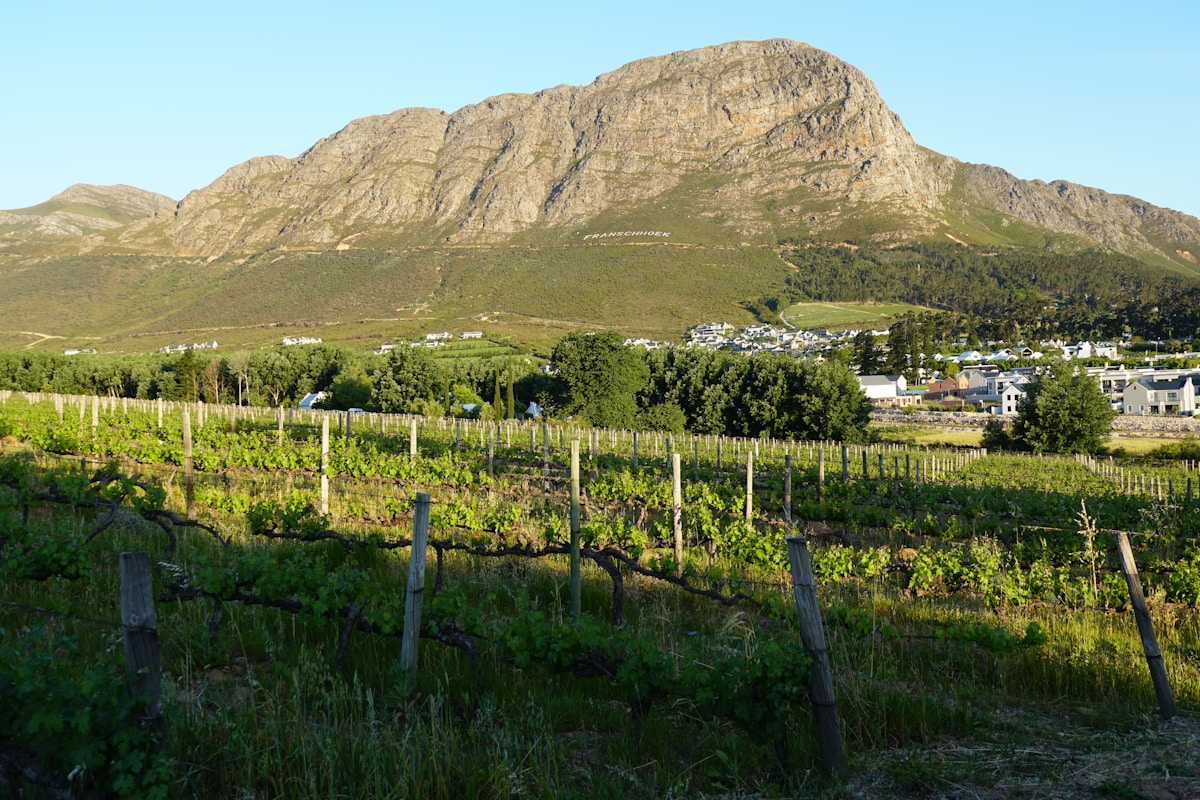
Stellenbosch and Franschhoek sit 30 km apart in the Cape Winelands and are South Africa’s two most famous wine towns. Both offer world-class wine, dramatic mountain scenery, and exceptional food. But they have distinct personalities - Stellenbosch is a university town with four centuries of Cape Dutch architecture; Franschhoek is a small French-influenced village built almost entirely around fine dining and luxury estates.
Quick Verdict
| Factor | Stellenbosch | Franschhoek |
|---|---|---|
| Size | Large town (~250,000 people) | Small village (~18,000 people) |
| Vibe | University town - lively, varied | Boutique, romantic, quiet at night |
| Wine | Over 200 estates nearby | Over 40 estates, all within valley |
| Restaurants | Strong variety - casual to fine dining | Elite - some of SA’s best restaurants |
| Cost | Moderate | Higher - 30–50% premium |
| Accommodation | Good budget to mid-range choice | Mostly boutique and luxury |
| Getting around | Walkable centre; car useful | Franschhoek Wine Tram excellent |
| Best for | First Winelands trip, day trips, longer stays | Anniversary, foodie pilgrimage, one special night |
Bottom line: Stellenbosch for a fuller experience with more variety and better value. Franschhoek for the world’s best wine tasting meals and a special-occasion atmosphere.
Character and Setting
Stellenbosch is South Africa’s second oldest town, founded in 1679, and its Cape Dutch streetscapes - whitewashed gables, oak-lined avenues, the Dorp Street museum strip - are remarkably intact. The presence of Stellenbosch University gives the town energy and keeps the restaurant scene diverse beyond the tourist set. Evenings on Church Street or Plein Street are genuinely fun.
Franschhoek (“French Corner”) was settled by Huguenot refugees in the late 1600s, which explains the French estate names, the bistro cafes, and the slightly Provençal feel of the main street. The Franschhoek Valley is smaller, steeper-sided, and entirely given over to wine. The main street, Huguenot Road, is about 2 km long and contains several of the country’s most celebrated restaurants, all of them adjacent to vineyards. It is quieter, more self-consciously beautiful, and noticeably more expensive.
Wine
Stellenbosch: The Stellenbosch Wine Route is South Africa’s most established and covers over 200 estates. Cabernet Sauvignon and Bordeaux-style blends are the flagship wines - Stellenbosch produces some of the most critically acclaimed reds in the southern hemisphere. Key estates:
- Rust en Vrede - long-ranked among SA’s best Cabernets; tasting from R200/flight (US$11) as of 2026
- Kanonkop - Paul Sauer Bordeaux blend; benchmark Pinotage. Tasting from R180 (US$10)
- Warwick - excellent Cabernet Franc; bicycle wine tours from R850 (US$47)
- Spier - family-friendly, extensive range; tasting from R100 (US$6)
Franschhoek: Franschhoek’s valley produces distinctive Chardonnay, Semillon, Pinot Noir, and Chenin Blanc. The estate dining experience is more intimate. Key estates:
- Haute Cabrière - cellar carved into the mountain; MCC (Cap Classique sparkling), tasting from R150 (US$8)
- La Motte - architect-designed estate; tasting R200 (US$11), excellent food
- Babylonstoren - extraordinary biodynamic garden estate; full-day experience; tasting from R180 (US$10)
- Graham Beck - definitive Cap Classique Brut; tasting from R120 (US$7)
Both valleys offer world-class wine. Stellenbosch dominates on big reds; Franschhoek on whites, sparkling, and estate experiences.
Food and Restaurants
Stellenbosch:
- Terroir at Kleine Zalze - farm-to-table, three-course lunch from R450 (US$25)
- Jardine at Jordan - fine dining overlooking dams and mountains; dinner from R650/person (US$36)
- Volkskombuiis - traditional Cape Malay and South African home cooking; mains from R160 (US$9)
- Craft Beer at Stellenbosch Brewing Co - pints from R50 (US$3), casual pub food
Franschhoek (elite tier):
- The Tasting Room at Le Quartier Français - regularly cited as the best restaurant in South Africa; tasting menu approximately R2,200/person (US$121) as of 2026. Reserve weeks ahead
- La Petite Colombe - seven-course French-influenced tasting menu, approximately R1,950/person (US$107)
- Babel at Babylonstoren - farm-grown produce, harvest-focused menu; lunch from R650 (US$36)
- Café BonBon - casual village bistro; mains from R130 (US$7)
All prices are approximate as of 2026. Fine dining restaurants in Franschhoek require advance booking, especially on weekends and in peak season (December–January, March).
Accommodation
Stellenbosch:
- Budget: Stumble Inn Hostel - dorms from R280/night (US$15)
- Mid-range: Oude Werf Hotel (historic 1802 building) - doubles from R2,200/night (US$121) as of 2026
- Splurge: Lanzerac Hotel & Spa - doubles from R5,500/night (US$302)
Search hotels in Stellenbosch on Booking.com
Franschhoek:
- Budget: Very limited - a few guesthouses from R1,200/night (US$66)
- Mid-range: Akademie Street Guesthouses - doubles from R2,500/night (US$138)
- Splurge: La Residence - Relais & Châteaux property, from R9,500/night (US$522). Le Franschhoek Hotel from R3,800/night (US$209)
Search hotels in Franschhoek on Booking.com
Franschhoek accommodation is scarce and premium - book ahead for weekends. The budget tier barely exists.
Getting Around
Stellenbosch: The historic town centre is very walkable - Church Street, Dorp Street, and the main estate area can all be covered on foot. Most wine estates are a 5–20 minute drive from town. A rental car gives full flexibility.
Franschhoek: The Franschhoek Wine Tram (hop-on-hop-off) is the definitive way to see the valley without a driver. Day pass approximately R360–R420 per person (US$20–US$23) as of 2026 - transport only, tastings billed separately at each estate. Routes depart from the main square. Tram is seasonal (operated year-round but schedules vary - check winetramsouthafrica.co.za). The village itself is walkable in 20 minutes.
Day Trip Logistics from Cape Town
- Stellenbosch: 50 km, approximately 45–60 minutes by car. Tour operators run half-day and full-day trips from around R1,200–R2,000/person (US$66–US$110) including tastings.
- Franschhoek: 80 km, approximately 75 minutes by car. Combined Stellenbosch + Franschhoek full-day tours run R2,000–R3,000/person (US$110–US$165) including tastings and lunch.
Driving after a full day of wine tasting is not safe and not recommended. Either take a tour with a driver, use the Wine Tram in Franschhoek, or arrange a designated driver.
How to Book a Guided Winelands Tour
Most visitors to the Winelands from Cape Town use either a small-group guided tour or a private vehicle tour. Here’s how the options break down:
Small-group shared tours (most popular for solo travellers and couples)
Operators running shared day tours from Cape Town to Stellenbosch and Franschhoek include Cape Fusion Tours, Full Day Winelands, and various GetYourGuide-listed operators. A typical full-day shared tour departs Cape Town at approximately 08:30, visits two to three estates in Stellenbosch, crosses the Helshoogte Pass, and arrives in Franschhoek for a late lunch and one or two afternoon tastings. Returns to Cape Town by 18:00–19:00.
Price range: R1,400–R2,200/person (as of 2026) for a shared tour including transport and some tastings. Estate lunches and additional tasting fees are usually paid separately on the day.
Browse guided Cape Winelands tours from Cape Town to compare operators, read verified reviews, and check available dates.
Private vehicle tours (best for groups of 3+, honeymoons, special occasions)
Private tours give full flexibility on timing, estates visited, and lunch venue. Rates start from approximately R2,800–R4,000 for a vehicle of two, dropping per head with larger groups.
Franschhoek-specific tours and wine tram packages - useful if you want to focus the day exclusively on the Franschhoek valley, including the Wine Tram circuit.
Stellenbosch wine estate tours - broader estate selection covering the Stellenbosch Wine Route, with options from bike tours (R850/person at Warwick) to cellar visits and blending sessions.
What to confirm before booking any Winelands tour:
- Whether estate tasting fees (typically R100–R300/person per estate) are included or payable on arrival
- Whether lunch is included or a restaurant stop is built in at your own cost
- Pickup point - most operators offer hotel pickup in central Cape Town; some require meeting at a central point
- Whether the Franschhoek Wine Tram is included or a separate booking (Tram tickets are approximately R360–R420/person in addition to tour fees if not bundled)
A combined Stellenbosch morning + Franschhoek afternoon in a single day is the most rewarding way to compare both towns - and with a driver handling navigation, you can focus on the wines.
Best For
Choose Stellenbosch if:
- First time in the Winelands - more variety in one visit
- You want a mix of wine, culture, and casual dining
- Budget or mid-range accommodation
- Spending more than one day in the area
Choose Franschhoek if:
- A special occasion - anniversary, birthday, proposal
- Fine dining is the main point of the trip
- Wine Tram experience is on the list
- You’re willing to pay a premium for a more contained, intimate experience
Most visitors who have time do both in a single long day, driving the Helshoogte Pass between them. It’s one of the most rewarding days out from Cape Town.
See our full Stellenbosch destinations guide and the Franschhoek Wine Tram activity page. For broader Winelands planning, see our Cape Winelands wine tasting guide. Both towns are day trips from Cape Town - see our Cape Town food guide for the city’s own dining scene.
Ready to plan your trip? Cape Winelands Tours, Car Hire in Cape Town, or Tours & Activities in Cape Town.
See Also
- Stellenbosch destination guide - full guide to South Africa’s wine capital
- Hotels in Stellenbosch - curated picks from guesthouses to wine estate stays
- Where to stay in Franschhoek - boutique hotels and wine estate accommodation in the valley
- Franschhoek Wine Tram guide - the hop-on hop-off wine experience in Franschhoek
- Cape Winelands day trip from Cape Town - how to structure a Winelands day from the city
- Cape Winelands vs Stellenbosch comparison - zoomed out version: is Stellenbosch alone enough?
- Western Cape region guide - the Winelands in the broader provincial context
- Cape Town vs Johannesburg comparison - the city comparison for your South Africa trip anchor point
- Garden Route vs Wild Coast - the coastal route decision after you’ve done the Winelands
Plan Your Trip
✈️ Book your flights to South Africa 🛡️ Get travel insurance 📱 Stay connected with an eSIM 🚗 Rent a car