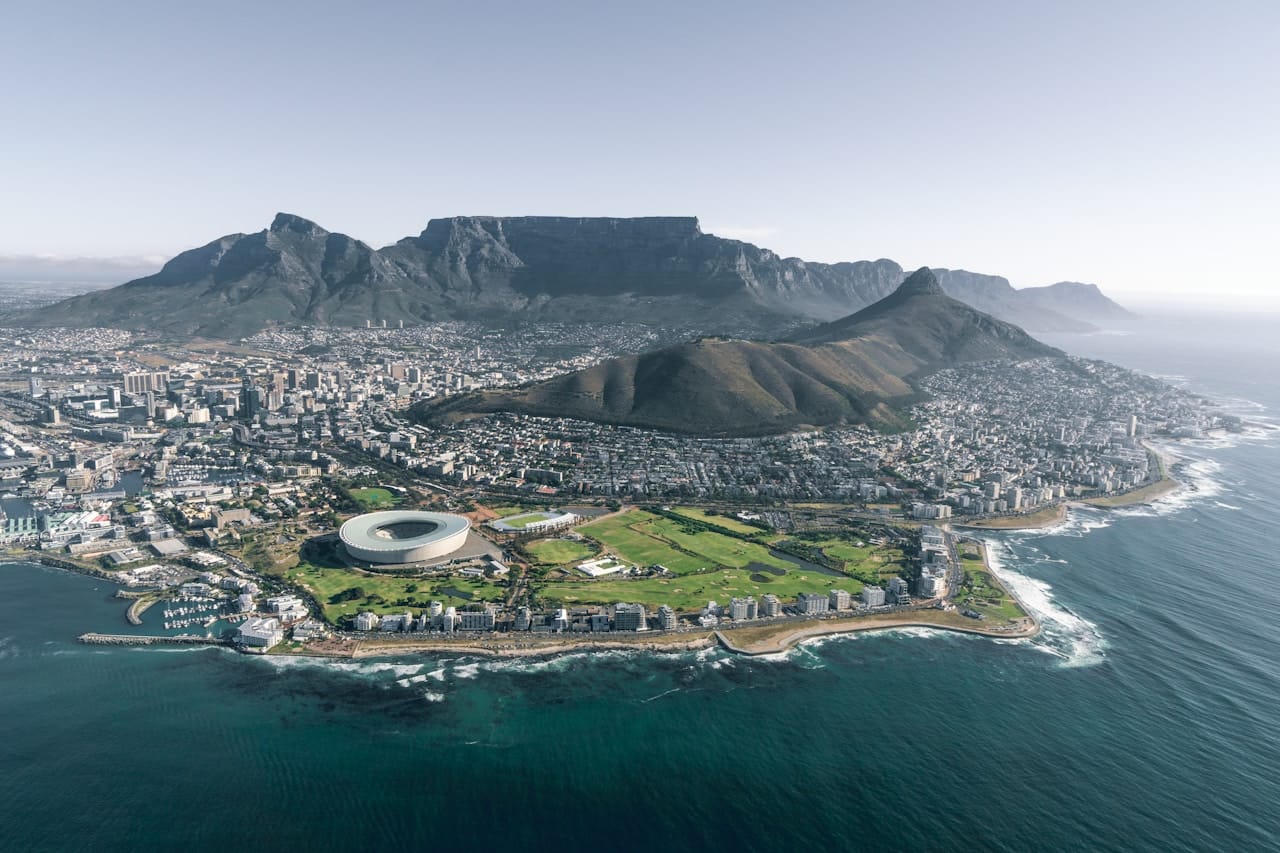
Cape Town International Airport (CPT) handles roughly 10 million passengers a year and connects the city to Johannesburg, Durban, and over a dozen international hubs. The airport is functional and relatively straightforward - arrivals, car hire, and transport links are all well-signposted. This guide covers every practical way to reach the city, with current fares and logistics.
For what to do after you arrive, see the Cape Town city guide or the Cape Town day trips guide for excursions from the city.
Flying to Cape Town
International Flights
Cape Town receives direct long-haul flights from Europe, the Middle East, and South America. The main international carriers operating direct services include:
- British Airways / Comair - London Heathrow direct (approximately 11 hours)
- Virgin Atlantic - London Heathrow direct
- KLM - Amsterdam direct (approximately 11.5 hours)
- Lufthansa - Frankfurt direct
- Turkish Airlines - Istanbul, with connections worldwide
- Qatar Airways - Doha hub, useful for connections from Asia and Australasia
- Emirates - Dubai hub, now operating three daily frequencies following the 2026 A350 upgrade
- Ethiopian Airlines - Addis Ababa, good for East Africa connections
- LATAM - São Paulo direct (launched 2025)
- Air Namibia - Windhoek
Return fares from London typically range from £450–£900 in economy booked a few months ahead. Business class fares from Europe start around £1,800–£2,500 return.
From within Africa, Cape Town connects to Nairobi, Lagos, Addis Ababa, Dar es Salaam, and Luanda on various carriers.
Domestic Flights from Johannesburg
The Johannesburg–Cape Town corridor is one of the busiest air routes in Africa. Multiple carriers compete, keeping prices relatively low:
| Carrier | Route | Typical advance fare |
|---|---|---|
| FlySafair | OR Tambo (JNB) or Lanseria (HLA) → CPT | R700–1,400 return |
| Kulula | OR Tambo (JNB) → CPT | R800–1,600 return |
| SA Airlink | OR Tambo (JNB) → CPT | R900–2,200 return |
| South African Airways | OR Tambo (JNB) → CPT | R1,000–2,500 return |
Prices are approximately $38–$135 USD at the R18–19 to $1 exchange rate (as of 2026). Book four to six weeks ahead for the best fares. Same-day tickets can reach R2,500–4,000.
Flight time is approximately 2 hours. Given the 14-hour drive, flying is almost always the right choice for the Joburg–Cape Town leg.
Domestic Flights from Durban
Durban King Shaka International (DUR) to Cape Town takes approximately 2 hours 15 minutes. FlySafair and SA Airlink operate this route. Return fares typically start from R900.
Domestic Flights from Other Cities
SA Airlink connects Cape Town to Port Elizabeth (now Gqeberha), George (for the Garden Route), East London, and Bloemfontein. These are shorter hops, usually under 2 hours.
Comparing fares before you commit saves real money, especially on the Johannesburg to Cape Town route: compare flights to South Africa across airlines and dates, and book as early as your plans allow for school holidays and December.
Bus from Johannesburg
For travellers on tighter budgets, intercity coaches offer an affordable if slow alternative.
Intercape is the most established operator, running daily departures from Johannesburg Park Station to Cape Town’s Adderley Street terminal. The overnight service departs late evening and arrives the following morning - approximately 17–18 hours door-to-door. Tickets start from R350 (approximately $19 USD) booked online; a reclining seat with air conditioning and limited toilet facilities is standard. Buses are generally reliable.
FlixBus entered the South African market and operates on major routes including this corridor. Fares are comparable to Intercape and the buses are slightly newer.
Greyhound previously operated this route but ceased operations in 2021. The Intercape and FlixBus options fill that gap.
The bus journey covers approximately 1,400 km. It’s a practical choice for travellers who have an extra day and want to see the landscape, though the overnight timing means you’ll see most of it in darkness. For those with time, breaking the journey at Beaufort West (roughly halfway) is possible.
Train from Johannesburg
The Shosholoza Meyl passenger train runs between Johannesburg and Cape Town on the long-haul Premier Classe service. The journey takes approximately 28–31 hours and is better understood as an experience than a transport option - delays of several hours are common.
Tickets start from R980 in a 4-berth compartment. The scenery through the Hex River Mountains and Karoo is genuinely spectacular in daylight hours. Book via the Passenger Rail Agency of South Africa (PRASA) website.
The Blue Train (a luxury heritage service) also runs Johannesburg–Cape Town. This is a bucket-list rail journey rather than practical transport - a two-day experience with 2026 fares from approximately R40,865 per person sharing one way. Compare it with Rovos Rail in our Rovos Rail vs Blue Train guide.
Cape Town International Airport: Arrivals
Location: 20 km east of the City Bowl, accessed via the N2 highway.
Facilities: The international terminal is compact. Car hire desks (Avis, Budget, Europcar, Hertz, Tempest) are in the arrivals hall. An ATM, currency exchange, and a small food court are available airside and post-customs.
Wifi: Free throughout the terminal.
Airport Transfer Options
MyCiTi Bus (Route A01) - The cheapest option from CPT to the city. The dedicated airport bus runs to the City Bowl (Civic Centre stop) for approximately R100 per person. Services run roughly every 20 minutes during peak hours. Journey time is 30–45 minutes depending on traffic. Luggage is permitted. This is the best option for travellers with standard luggage who are heading to central accommodation.
Uber - Uber works reliably at CPT. The app shows prices upfront: expect R200–350 to the City Bowl or V&A Waterfront, R280–400 to Sea Point, and R350–500 to Camps Bay, as of 2026. Uber pick-up is from the designated area outside arrivals.
Metered Taxis - Official airport taxis are available from the pre-paid taxi desk in arrivals. Fares are fixed by zone: approximately R450–500 to the City Bowl, R550–650 to Camps Bay. They’re more expensive than Uber but don’t require a smartphone.
Car Hire - Desks from all major agencies are in the arrivals hall. Hiring at the airport adds a slight premium (typically R50–100/day) over off-airport locations. For travel to the Winelands, Cape Peninsula, or Garden Route, having a car from day one is usually the right call. See the South Africa car hire guide for rates and tips.
Hotel Shuttles - Many city centre and V&A Waterfront hotels offer complimentary or paid airport transfers. Check with your accommodation in advance.
Arriving late, with heavy luggage or with children? Pre-book a private transfer for South Africa or arrange a Welcome Pickups driver for a fixed price and a named driver waiting in arrivals. Check coverage for your route before paying. Our Cape Town airport transfer guide covers every option side by side.
For a self-drive trip from day one, compare car hire at Cape Town before you fly, as airport desks fill up in peak season.
Getting to Cape Town from Other Western Cape Towns
If you’re arriving from elsewhere in the Western Cape:
- Stellenbosch: 50 km east on the N2 - 40 minutes by car; no direct public transport
- Hermanus: 120 km east on the N2/R43 - 90 minutes by car
- George (Garden Route): 430 km on the N2 - 4 hours by car, or a short domestic flight via George Airport (GRJ) with SA Airlink
For full transfer pricing and taxi booking, see the airport transfers guide.
Plan Your Trip
- Cape Town city guide - what to do once you arrive
- Where to stay in Cape Town - compare hotels and guesthouses by area
- Cape Town day trips - Winelands, Hermanus, Cape Peninsula
- Getting around South Africa - hire car, Uber, buses and Gautrain compared
- Airport transfers - detailed booking options and operators