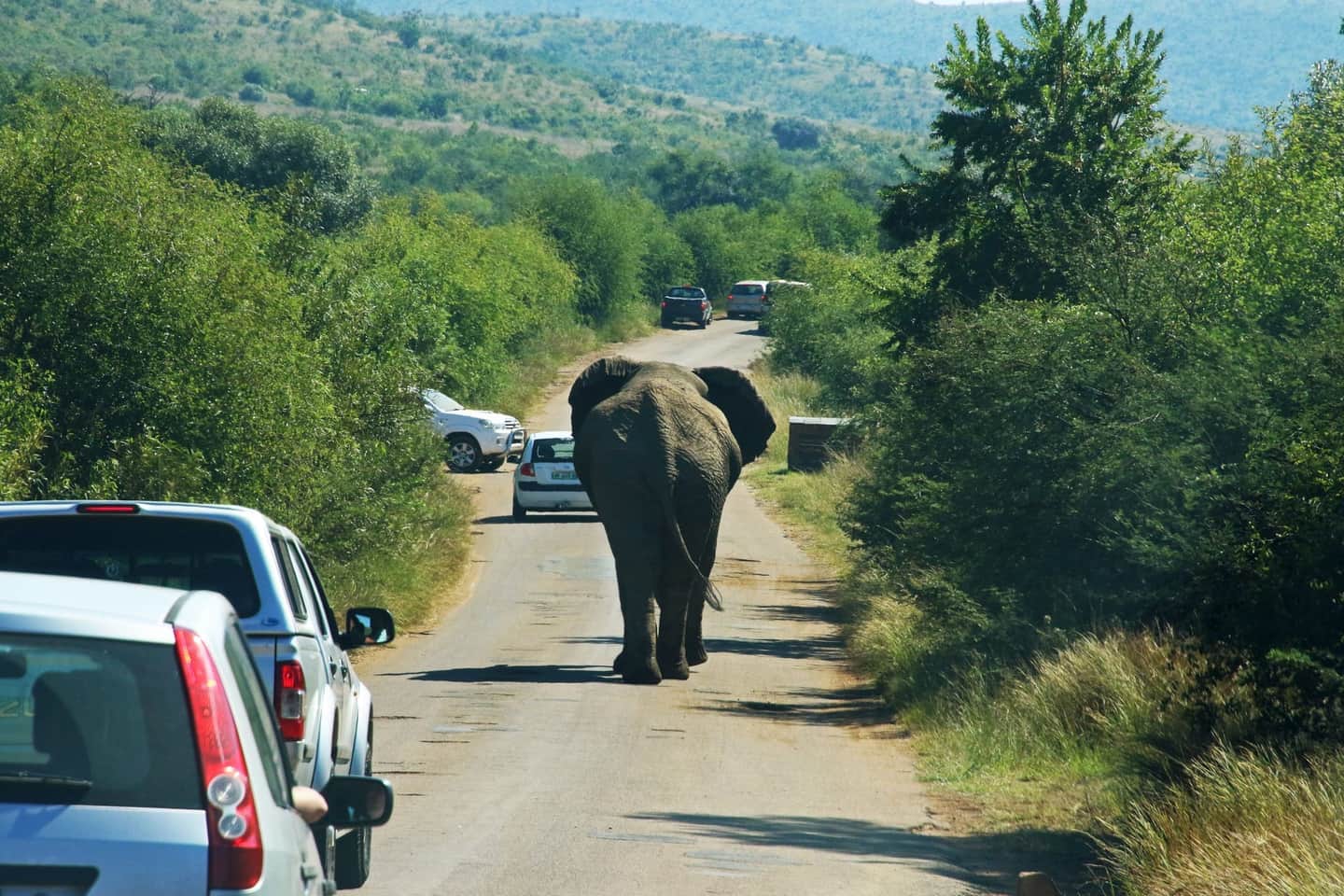
Kruger and Addo are South Africa’s two most visited national parks — and the two destinations that come up in almost every first-trip planning question. Kruger is the country’s flagship: vast, predator-rich, and the name most people picture when they think “South African safari.” Addo is something different: malaria-free, compact, and positioned at the end of the Garden Route for travellers already circling the Western Cape.
The choice isn’t really about which is “better.” It’s about where your trip starts, who’s travelling with you, and whether malaria is a factor.
Quick Verdict
| Factor | Kruger | Addo |
|---|---|---|
| Size | 19,485 sq km | 1,640 sq km (main section) |
| Distance from Cape Town | 1,600 km / fly to MQP or HDS | 750 km / fly PLZ (1.5 hr) |
| Distance from Johannesburg | 430–500 km (5–6 hrs) | 1,050 km / fly PLZ |
| Malaria risk | Yes — prophylaxis recommended | None — entirely malaria-free |
| Big Five | All five, reliably | All five present |
| Self-drive | Yes — 2,500+ km of roads | Yes — manageable road network |
| Elephant density | High (~13,700 elephants) | World’s highest elephant density |
| Predator density | High — lion, leopard, cheetah, wild dog | Leopard present; lion and cheetah uncommon |
| Entry fee (international) | R396/day as of 2026 (SANParks) | R396/day as of 2026 (SANParks) |
| Typical stay | 3–5 days minimum | 2–3 nights |
| Best season | May–September | Year-round; June–September best |
Bottom line: Kruger for a dedicated safari trip with time to do it properly. Addo for families, Cape Town–to–Garden Route itineraries, or anyone who needs a malaria-free Big Five experience.
The Wildlife
Kruger: The numbers are hard to argue with. Over 147 mammal species, 500+ bird species, an estimated 13,700 elephants, 27,000 buffalo, and 2,800 lions. Leopard density in the south is among the highest in Africa. Wild dog packs roam the north. The scale — nearly 20,000 sq km — means you can spend five days and still be seeing new landscapes and new concentrations of game. The southern section (Skukuza, Lower Sabie, Berg en Dal) is richest for the Big Five on a first visit.
Addo: Addo was established in 1931 to save the last 11 elephants in the Eastern Cape. Today, more than 600 elephants roam the park — the highest density of any park in the world. Buffalo herds are large and very visible. Black rhino sightings are more reliable here than almost anywhere else in South Africa. Lion are present but range widely, so sightings aren’t guaranteed for short-stay self-drivers. Leopard occur but are elusive. The “Big Six” is sometimes used for Addo: the marine section of the park (accessible separately at Cape Seal and Bird Islands) adds southern right whales and great white sharks to the list.
Addo doesn’t try to be Kruger. It’s a genuine Big Five destination — particularly excellent for elephants, rhino, and buffalo — but if seeing lions reliably over 2–3 days is the priority, Kruger delivers that more consistently.
Malaria
This is the most practically decisive difference for many travellers.
Kruger: Lies in a malaria zone across Limpopo and Mpumalanga provinces. Prophylaxis is strongly recommended year-round, with the highest transmission risk during the summer rainy season (November–April). Consult a travel clinic 4–6 weeks before departure. Common options: atovaquone-proguanil (Malarone), doxycycline, or mefloquine.
Addo: The Eastern Cape is entirely malaria-free year-round. No prophylaxis is needed. This is the decisive advantage for:
- Families with infants or young children (dosing restrictions for children on antimalarials)
- Pregnant travellers (most antimalarials are contraindicated)
- Anyone who reacts poorly to prophylaxis or on medication that interacts with it
- Short trips where starting a prophylaxis course isn’t practical
See Health and vaccinations for South Africa for a full breakdown of malaria zones and recommended antimalarials.
Getting There
To Addo:
- From Cape Town: Fly to Gqeberha (PLZ) — approximately 1 hour, from R1,000 one-way as of 2026. Drive 45–60 minutes to Main Camp gate. Total door-to-door: under 2.5 hours.
- Along the Garden Route: Storms River to Addo is 230 km, roughly 2.5–3 hours via the N2. The natural last stop on a Cape Town–Garden Route road trip.
- From Johannesburg: Fly to PLZ (1.5 hours, from R1,200) or drive (1,050 km, not recommended without a stop). Flying is by far the better option.
- From Durban: Drive via the N2 (720 km, 8 hours) or fly (1 hour). Most KZN visitors choosing Addo fly.
To Kruger:
- From Johannesburg: Drive to Numbi or Paul Kruger Gate — 430–440 km, 5–5.5 hours. Or fly to Kruger Mpumalanga International (MQP, Nelspruit) — 1 hour, from R1,200. Transfer adds 1 hour to reach south Kruger.
- From Cape Town: Fly to MQP or Hoedspruit (HDS). No direct CPT–HDS on all days; CPT–JNB–MQP is the reliable routing (2.5 hours total). Then drive into the park.
- From Durban: Drive approximately 5–6 hours to southern Kruger or fly JHB–MQP.
Verdict on access: Addo is dramatically easier from Cape Town. Kruger is easier from Johannesburg. If your trip starts in Cape Town and ends with a flight from Johannesburg, Addo at the end of the Garden Route is the more logical circuit — and saves doubling back.
Cost
Both Kruger and Addo are SANParks properties, so international visitor entry fees are identical.
Entry fee (both parks): R396/person/day as of 2026. Check sanparks.org before visiting — fees are reviewed annually.
Kruger accommodation:
- SANParks restcamps: R600–R2,200/night for a cottage (2 adults), depending on camp and season
- Private lodges adjacent to Kruger: R4,000–R20,000/night (game drives included)
- Skukuza, Lower Sabie, Berg en Dal, and Satara are the main self-catering options
Search hotels near Kruger National Park on Booking.com
Addo accommodation:
- Main Camp (SANParks): Forest chalets and cottages from approximately R900–R1,800/night for 2 adults as of 2026
- Nyathi Rest Camp: Quieter upscale camp in its own valley, from approximately R2,900/night
- Luxury private: Gorah Elephant Camp (inside park, full-board) from approximately R10,000 per person; RiverBend Lodge from approximately R7,500 per person
- Mid-range: Hitgeheim Country Lodge or Africanos Country Estate, from R1,900–R2,600/night
- Budget: Avoca River Cabins (self-catering, from R950) or Orange Elephant Backpackers (dorms from R300)
Search hotels in Addo on Booking.com
For a 2-night trip, Addo can be marginally cheaper — SANParks restcamp pricing is similar, but Addo is smaller so fewer nights are needed. For a 5-day dedicated safari, Kruger’s scale delivers more value per day.
Self-Drive Experience
Both are excellent self-drive parks — uncommon in the African context.
Kruger: Over 2,500 km of roads (mix of tar and gravel). Speed limit 50 km/h on tar, 40 km/h on gravel. Stay in the vehicle except at designated rest stops. The southern section (S3, H1-2, H4-1, S28 — Skukuza to Lower Sabie) is the classic first-timer route. Download the SANParks app for offline maps and recent sighting reports. Gates open at 5:30–6:00 am depending on season — be there at opening.
Addo: More compact and easier to navigate. The main tar loops — Doringhoek Drive, Hlosi Game Loop, and the roads around Hapoor Waterhole — are clearly signposted and navigable in a standard sedan. The night waterhole at Main Camp (lit, visible from camp) is one of Addo’s standout features: elephant and buffalo come in after dark, visible without leaving camp.
Tip for both: the first two hours after gate opening and the last two before sunset are when predators are most active. The middle of the day (10:00–15:00) is the least productive for big cat sightings.
Which Is Right for Your Trip?
Choose Kruger if:
- You have 3–5 days or more for a dedicated safari
- Big cat sightings — especially lion — are a priority
- You’re flying into or out of Johannesburg
- Variety of game, scale, and birding matter to you
- You want the definitive South African wildlife experience
Choose Addo if:
- You’re already doing the Garden Route from Cape Town
- Malaria is a concern — especially families with young children or infants
- 2–3 nights is all the time you have for wildlife
- Elephants and rhino are your priority
- You want to combine a safari with the Eastern Cape coast
Both, if your itinerary allows: A typical 14-day South Africa trip will often include Cape Town → Garden Route → Addo → flight to Johannesburg → Kruger → return. This covers both parks without backtracking and gives context for how different they are.
For full detail on each park, read our Kruger National Park guide and Addo Elephant National Park guide. Comparing safari options specifically for families or those avoiding malaria? See our malaria-free safari guide.
Browse Addo safaris and tours | Browse Kruger safaris and tours
See Also
- Kruger vs Pilanesberg — Johannesburg-based safari decision with similar malaria trade-off
- Self-drive vs guided safari in South Africa — which works better at Addo and Kruger
- 5-day Kruger safari itinerary — day-by-day Kruger plan if Kruger wins
- 7-day Garden Route itinerary — includes Addo as a natural final stop
- South Africa safari cost guide — full budget breakdown for both parks
- Best time to visit South Africa — when to go for best game viewing
- South Africa vs Kenya safari — if you’re still weighing African safari destinations
- Kruger vs private game reserves — self-drive vs luxury lodge within the Kruger ecosystem